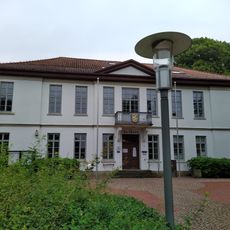
Erbhof Thedinghausen, Renaissance château in Thedinghausen, Germany.
Erbhof Thedinghausen is a two-storey brick manor house built from 1619 for Archbishop Johann Friedrich of Bremen. Its main facade has three projecting bays: the central one holds a spiral staircase, while the two side bays belong to a slightly later building phase, visible in the joints. Richly decorated sandstone gables, frames and pilasters divide the unplastered walls, and portrait medallions repeat the same likenesses of Gertrud von Hermeling-Heimbruch and the archbishop.
Bremen's Lutheran archbishop Johann Friedrich met Gertrud von Hermeling-Heimbruch here in 1612, on the estate of her husband Heinrich Corlehake Hermeling, who bequeathed the property to his sovereign in 1613. After Heinrich's death the archbishop built the present house from 1619 as a fitting residence for Gertrud, but she died on 16 March 1620 while work was still under way. In 1621 he gave the completed Erbhof to his son Friedrich.
Portrait medallions on the façade repeat the same likenesses of Gertrud von Hermeling-Heimbruch and Archbishop Johann Friedrich, the couple for whom the house was built. The building is commonly counted as Weser Renaissance, yet its ornament — scrollwork turning toward cartilage style — already marks the transition from Mannerism to early Baroque.
Visitors can join guided tours called 'Perle der Weserrenaissance' to learn about the architectural style and the building's past. These tours allow you to see the layout and crafted details up close from a knowledgeable perspective.
A yew tree beside the manor, said to have been planted in 1621 as a four-year-old sapling to complete the castle garden, was named a National Heritage Tree in 2023. With a trunk circumference of almost five metres, it is considered the thickest yew publicly accessible in Germany.
The community of curious travelers
AroundUs brings together thousands of curated places, local tips, and hidden gems, enriched daily by 92,978 contributors worldwide.