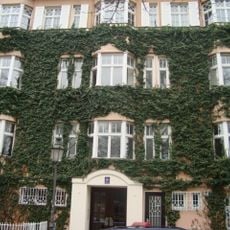
Seidlvilla, Cultural center in Schwabing, Munich, Germany
The Seidlvilla is a villa built in 1905 at Nikolaiplatz 1b in Munich's Schwabing district, designed by architect Emanuel von Seidl in German Renaissance style with Art Nouveau forms. The original complex consisted of a main house with a side wing for coach house, stables and coachman's lodging, enclosed by a garden wall with vase-topped pillars.
Architect Emanuel von Seidl designed the villa in 1905 for Franziska Lautenbacher, who had inherited wealth from her marriage to a Spaten brewery owner. The building later served as a police station between 1979 and 1987 before undergoing renovation and reopening as a cultural center.
The Seidlvilla is run as a citizens' centre: the Bürgerzentrum Seidlvilla association opened it in June 1991 after the city bought the villa in 1976. The Seerosenkreis, founded in 1948 for literary and visual artists, holds events here, including an annual Christmas reading at the fireplace. The Schwabing district committee, the local archive and the neighbourhood help service are also based in the building.
The villa at Nikolaiplatz 1b is owned by the city of Munich and hosts public events run by the Bürgerzentrum Seidlvilla, the Münchner Volkshochschule and the Seerosenkreis, including an annual Christmas reading by the fireplace. The Schwabing district committee, the local archive and the neighbourhood help association also have offices in the building, so opening times depend on the respective organiser.
The police station was meant to stay three years but remained until 1987 because a planned new building was delayed. During those years the villa was also rented out for filming: episodes of Schulmädchen-Report and a 1972 instalment of Der Kommissar with Erik Ode were shot there.
The community of curious travelers
AroundUs brings together thousands of curated places, local tips, and hidden gems, enriched daily by 93,875 contributors worldwide.