Erdenburg, Iron Age hillfort in Moitzfeld, Bergisch Gladbach, Germany
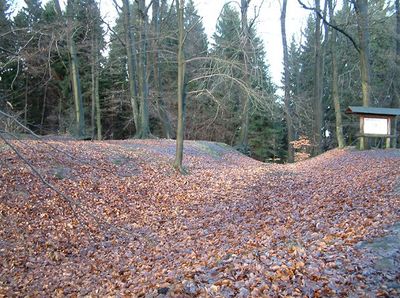
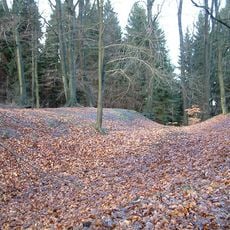
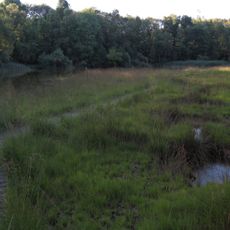
Erdenburg is an Iron Age hillfort on a ridge east of Bensberg in the Moitzfeld district of Bergisch Gladbach, within the Hardt nature reserve. Three concentric ditches about two metres deep enclose an oval roughly 230 by 165 metres, with ramparts built in murus gallicus timber-and-earth construction. The western entrance gate is documented; the ramparts on the northeast side are flattened or missing.
Excavations in 1935, organised by Werner Buttler and Hans Schleif and financed by the Waffen-SS, dated the Erdenburg to the Late La Tène period and framed it as a Germanic fort against Rome, although the site lay in Ubii territory. In 1968 Hermann Schwabedissen radiocarbon-dated charcoal from the base of the rampart to 310 ± 80 BCE; he later reportedly revised this orally to 90 ± 50 BCE. The ramparts thus predate the Roman conflicts.
The site shows how people here protected their communities more than 2000 years ago by building ramparts and ditches. This location reflects the everyday security concerns of that time and explains why hilltop positions mattered so much.
You can reach the site via marked trails from central Bergisch Gladbach. Information boards along the way explain the archaeological finds and why this fortification mattered to ancient peoples.
The ramparts were rebuilt in 1935 by Nazi forced labourers and local firms after the "Jungfrau" quarry had destroyed the eastern ring wall. The 1935 excavations, organised and financed by the Waffen-SS, were used to cast the site as a Germanic defence against Rome, although the Ubii lived here and were allied with Rome.
The community of curious travelers
AroundUs brings together thousands of curated places, local tips, and hidden gems, enriched daily by 94,333 contributors worldwide.