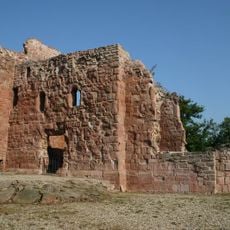
Rothenburg, Castle ruin in Kyffhäuserland, Germany.
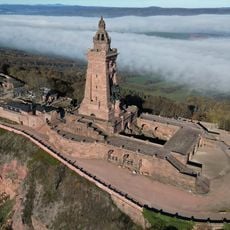
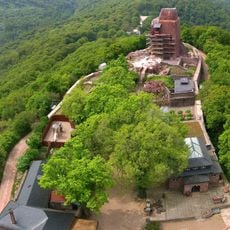
Rothenburg is a ruined hilltop castle on a steep spur at the northwestern edge of the Kyffhäuser Mountains, at 350 m above sea level in Steinthaleben. Its oval core was separated from the ridge by a wall and ditch and guarded by a round keep about 12 m in diameter with walls nearly 3 m thick and a remaining height of 12 m. East of the keep, a gate path over a drawbridge led through the main building, the 20 × 9.5 m Grafenhaus, into the courtyard; north of it lie the chapel ruins. Red sandstone, the probable source of the name, was the main building material.
The fortress was first documented in 1103 and served as an important stronghold under the rule of the Counts of Beichlingen. Emperor Otto IV damaged it severely in 1212 during the struggle between the Staufer and Welfen families.
The name Rothenburg derives from the reddish color of the stone that becomes visible from elevated vantage points. The layout and position of the stronghold reflect how medieval lords chose defensible locations to control surrounding territory.
The ruin has been closed since 2010 for restoration work, and the grounds can no longer be entered. The hiking trail that once crossed the castle site has been rerouted, so walkers now pass the Rothenburg outside the walls. The site lies on a steep spur at 350 m on the northwestern edge of the Kyffhäuser range, above Steinthaleben.
Around 1300 the famous minnesinger Christian von Luppin stayed at the Rothenburg, which was then held by the Counts of Beichlingen, who named their line after the castle. In the 15th century, during restoration work, the decayed chapel yielded the puzzling figure of the Püstrich von Sondershausen, which entered the Schwarzburg princely cabinet of naturalia and curiosities in Sondershausen.
The community of curious travelers
AroundUs brings together thousands of curated places, local tips, and hidden gems, enriched daily by 94,453 contributors worldwide.