Erlöserkirche, Modern church in Wuppertal, Germany
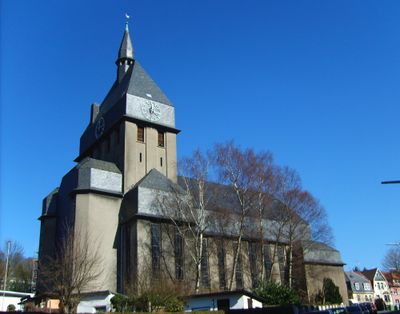
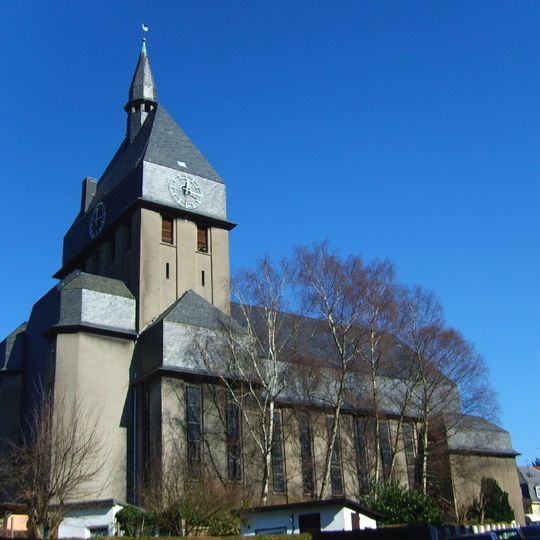
Erlöserkirche is a rendered, multi-storey church in the Heimatstil built in 1913–1914 to Wilhelm Werdelmann's plans in Wuppertal-Barmen. Its slate-clad body with high mansard roofs suggests a Latin cross with a crossing tower, but the square west tower and side wings are additions unrelated to the interior. The tower carries a pale clock face and, above two tall narrow windows, a steep pyramidal slate roof with a small spire. Inside, the hall held 1,200 seats under a barrel vault with column-free galleries on three sides.
The Lutheran congregation of Wichlinghausen decided in 1912 to build for its western new districts; the church was erected in 1913–1914 to plans by the Barmen architect Wilhelm Werdelmann. Its tower carries the weathercock of the old Wichlinghausen church of 1744. In 1984 the Lutheran and Reformed congregations merged, and in 2003 Nächstebreck joined to form the Evangelical congregation Wichlinghausen-Nächstebreck. An arson attack on 30 October 2016 badly damaged the interior and the organ.
The tower carries the weather vane of the old Wichlinghausen church of 1744, kept when the new building was planned. Since 1984 the Lutheran congregation has been united with the Reformed one, and since 2003 Nächstebreck with its Hottenstein church belongs to the same parish, Wichlinghausen-Nächstebreck. With the Wichlinghausen church in the centre closed, the Erlöserkirche remains the only preaching place in Wichlinghausen, at the western edge of the parish.
The church stands at the western edge of the Wichlinghausen parish area in Barmen. The community rooms in the lower floor were unusable from the 2016 fire until construction work finished in 2020, so check locally before planning a visit inside. The building is a listed monument of North Rhine-Westphalia.
The tower carries the weather vane of the old Wichlinghausen church from 1744, a detail easy to miss from street level. Inside, the free-standing principal pipes of the first organ were left on the east gallery during the 1970s rebuild for visual reasons and are still there, though the instrument now in use is a 1951 Paul Faust organ with 25 stops.
The community of curious travelers
AroundUs brings together thousands of curated places, local tips, and hidden gems, enriched daily by 94,054 contributors worldwide.