Enver-Pascha-Brücke, Road bridge in Babelsberg, Germany
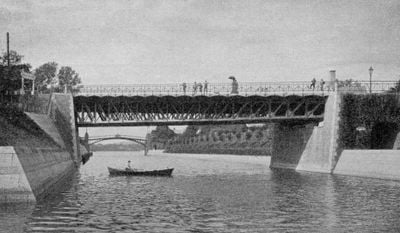
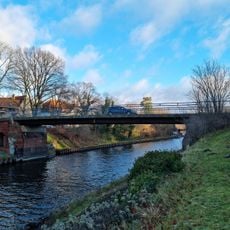
The Enver-Pascha-Brücke is a road bridge crossing the Teltow Canal between Neubabelsberg and Klein Glienicke. It connects Glienicke Avenue with Wannsee Street and has separate sections for pedestrians and vehicles.
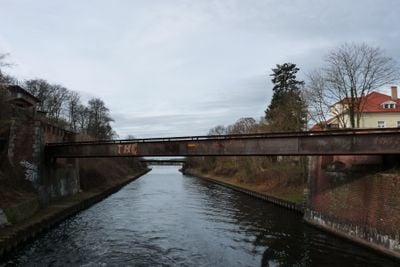
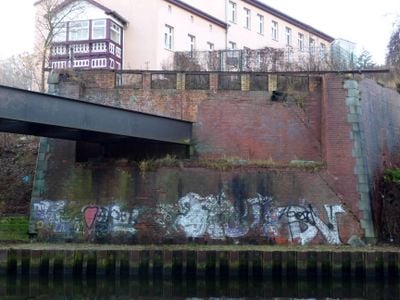
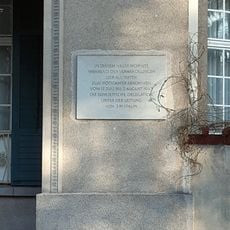
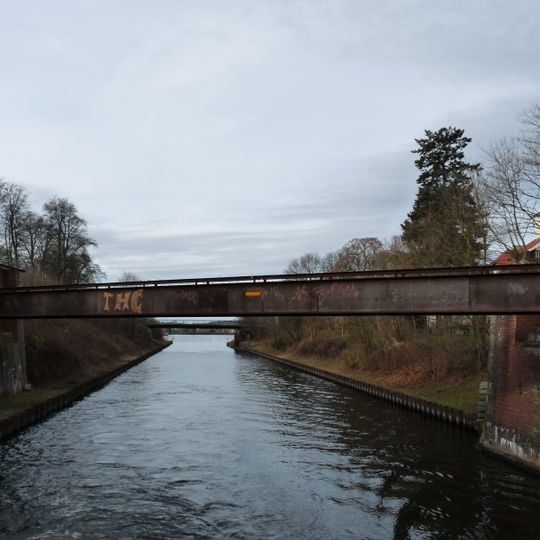
Completed on 3 September 1901, the bridge was about 30 metres long and 10 metres wide, linking the avenue to Glienicke with Wannseestraße. It was originally called Babelsberger Brücke or Schlossbrücke after nearby Babelsberg Palace, and was renamed after Enver Pasha in 1915. German troops blew it up in 1945; plans from 1952 to rebuild it were never carried out, and in the 1970s two non-walkable double-T girders were mounted between the surviving abutments to carry pipes and cables.
The bridge was named in 1915 after an Ottoman military officer who served as a diplomat in Berlin in the early 1900s. This name choice reflects a historical connection between Germany and the Ottoman Empire during that era.
The bridge no longer exists: German troops blew it up in 1945, and only the abutments remain. Since the 1970s two non-walkable double-T girders between the preserved bridgeheads carry pipes and cables, so the crossing cannot be used on foot or by vehicle. The neighbouring Parkbrücke took over road traffic.
The bridge no longer exists as a crossing: since the 1970s two non-walkable double-T girders have been mounted between the surviving abutments, carrying pipes and cables across the Teltow Canal. The name was officially revoked and struck from Potsdam's street register on the initiative of the Sozial.Die Linke faction, because Enver Pasha is considered a main responsible figure for the 1915 Armenian genocide.
The community of curious travelers
AroundUs brings together thousands of curated places, local tips, and hidden gems, enriched daily by 93,967 contributors worldwide.