Castra of Dambach, Ancient Roman fort in Bavaria, Germany
Kastell Dambach is a Roman military camp on the Rhaetian Limes, lying mostly unbuilt-over but invisible in the fields east of Dambach, a village in the municipality of Ehingen, Bavaria. Its elongated ground plan, dictated by its construction history, is unmatched along the Upper Germanic-Rhaetian Limes. The site occupies a shallow basin cut by the Moosgraben, about 100 metres behind the Limes line.
The stone fort was built late in the sequence of Rhaetian Limes forts, after an earlier timber phase; its elongated plan is unmatched along the Upper Germanic-Rhaetian Limes. Two large camp villages (vici) grew beside it, and the waterlogged subsoil preserved wooden structures and finds. A spring sanctuary with many votive offerings stood nearby. The site lies mostly unbuilt but invisible east of Dambach.
The site's name in older literature, Kastell Hammerschmiede, comes from the nearby Kreitmühle forge, whose owner showed early visitors Roman masonry and oak beams. The waterlogged clay soil of the camp village has preserved wooden structures and votive offerings from a local spring sanctuary, finds that are otherwise rare along the Raetian Limes.
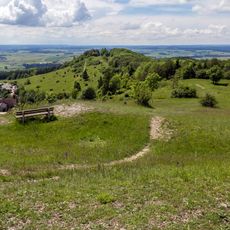
The fort lies in a wet hollow east of Dambach, mostly built over and not visible; the site was altered by pond construction and a brickworks that operated until World War I. The Limes runs down into the Moosgraben valley north of the fort, and about 250 metres away, some 50 metres behind the Limes wall, low earth banks enclose an oval area.
The oval earthwork lies not inside the fort but about 250 metres away, roughly 50 metres behind the Limes wall in the wooded area called the Heide. Its low mounds enclose an oval area where a small timber-and-earth amphitheatre probably stood, a type known at several Limes forts.
The community of curious travelers
AroundUs brings together thousands of curated places, local tips, and hidden gems, enriched daily by 94,353 contributors worldwide.