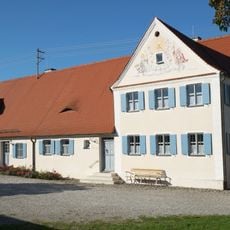
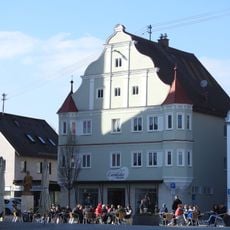
Schloss Höchstädt, Royal palace in Höchstädt an der Donau, Germany.
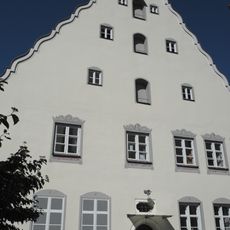
Schloss Höchstädt is a three-storey late Renaissance palace built between 1589 and 1603 on a rectangular plan with more than 120 rooms, stepped gables, stair turrets and four round corner towers. A Gothic bergfried from an earlier building was incorporated and breaks the symmetry. The German Faience Museum, opened in 2010, occupies nearly 900 square metres and shows about 1,000 pieces from 58 manufactories.
The palace was built between 1589 and 1603 by Graubünden masons following designs by Lienhart Grieneisen. It served as a widow's residence for Duchess Anna until 1632 and became closely associated with the 1704 Battle of Höchstädt, a turning point in the War of Spanish Succession.
The chapel's wall paintings date from the palace's construction around 1600 and record the Protestant faith of Duchess Anna von Jülich-Kleve-Berg, who lived here from 1615 to 1632 while her son Wolfgang Wilhelm converted to Catholicism. Stucco ceilings and inlaid portals survive in the state rooms.
Visitors enter through the main gate and can explore the museum rooms around the courtyard as well as the chapel and Gothic tower. The best time to visit is during daytime hours when natural light illuminates the architectural details and the chapel paintings.
In 1944 the ERR stored over 550,000 cultural objects and scientific material in the palace, including 14 railway wagons from Ukraine and 4 wagons of museum pieces from Minsk. A group of Ukrainian scholars was housed here to inventory the haul. In 1945 the objects went to the Central Collecting Point in Munich and were returned to the Soviet Union in 1946.
The community of curious travelers
AroundUs brings together thousands of curated places, local tips, and hidden gems, enriched daily by 94,254 contributors worldwide.