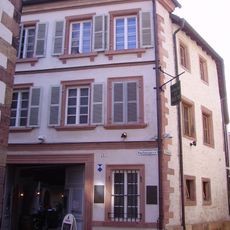
Fortress of Landau, Polygonal fortress in Landau in der Pfalz, Germany
The fortress of Landau was a polygonal bastion fort built between 1688 and 1691. Its ground plan was an elongated octagon with seven bastions and a reduit, surrounded by a wet ditch fed by the Queich and an outer crown work on the northwestern hill. Most surviving structures lie below street level, including sluices, walls along the watercourses and the 3.3 km of walls of the fort built in 1702.
French military engineer Sébastien Le Prestre de Vauban designed and built this fortress between 1688 and 1691 as part of Louis XIV's defense strategy. The installation was thus an example of the advanced fortification techniques of its time.
The two surviving gates, Deutsches Tor and Französisches Tor, were kept standing on the initiative of Wilhelm Schech, city architect from 1886, during the demolition of 1871. The Queich still runs through Landau, the river that once fed the moats and could flood two thirds of the citadel.
The Französisches Tor houses a restaurant where visitors can dine while surrounded by historical military architecture. The location is easily reached on foot and the exterior grounds can be freely explored.
The fortress walls were partially built using stones from a medieval castle that once stood in the northwestern corner of Landau's city center. These reused materials thus carry evidence from two different periods of the city's history within them.
The community of curious travelers
AroundUs brings together thousands of curated places, local tips, and hidden gems, enriched daily by 94,271 contributors worldwide.