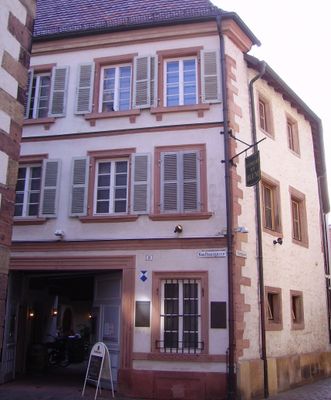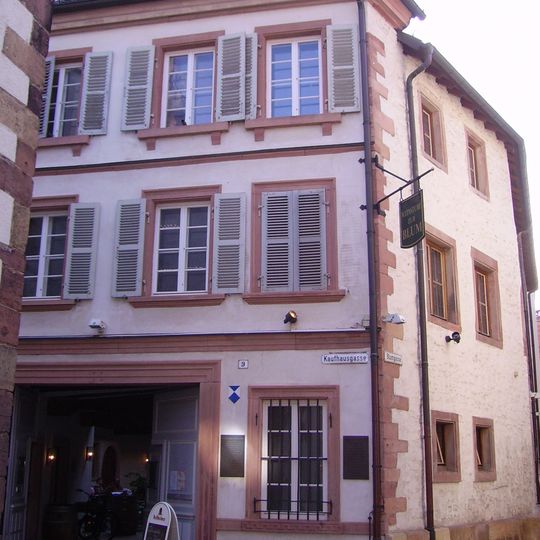
Frank-Loebsches Haus, Cultural heritage monument in Landau in der Pfalz, Germany
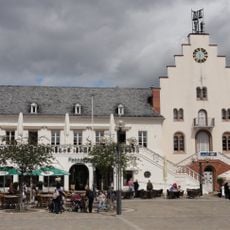
Frank-Loebsches Haus is a three-story cultural heritage building in Landau with arcaded passageways and a Renaissance staircase tower at Kaufhausgasse 9. The structure houses exhibition spaces about Jewish history as well as offices of academic institutions within its rooms.
The building was probably erected between the 15th and 17th centuries and was long privately owned, last by an innkeeping family who ran the "Wirtschaft zur Blum[e]" there. In 1870 Zacharias Frank, Anne Frank's great-grandfather, bought it as a residence. Under National Socialism the Frank-Loeb family was expropriated and the house in the Kaufhausgasse was used as a Judenhaus; the city bought it in 1987 and has used it for art and exhibitions since.
The house is named after the Jewish Frank-Loeb family, and in Landau it is regarded as a symbol of Jewish culture before the Nazi period. Since 1987 the city has used it for art and exhibitions, and it also houses the Frank-Loeb Institute, founded in 1997, which runs public talks such as the Hambacher Gespräche and the Landauer Akademiegespräche with guests from politics, academia and the judiciary.
The building sits centrally on Kaufhausgasse and is easily accessible on foot from the historic city center. Visitors should know that the upper floors contain exhibition spaces and stairs are needed to explore them.
The Frank-Loeb Institute, founded in 1997, has awarded a guest professorship since 2009; holders include Alfred Grosser (2009), Klaus Töpfer (2010) and Martin Schulz (2024). Its Hambacher Gespräche and Landauer Akademiegespräche bring figures such as Peter Altmaier and Margot Käßmann to the house. Ulrich Sarcinelli was founding director; Manuela Glaab now leads it.
The community of curious travelers
AroundUs brings together thousands of curated places, local tips, and hidden gems, enriched daily by 94,272 contributors worldwide.