Hauptstraße, Pedestrian shopping street in Innere Neustadt, Dresden, Germany
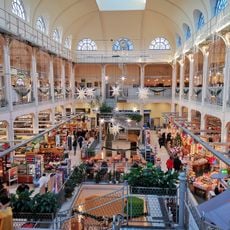
Hauptstraße is a 400-metre pedestrian street running from Neustädter Markt to Albertplatz, the axis of Dresden's Innere Neustadt. It is 57 metres wide at the market end and 38 at Albertplatz, lined mostly with five-storey prefabricated blocks whose ground floors hold shops; on the west side 18th-century buildings survive. The Dreikönigskirche and the Neustädter Markthalle stand at its middle.
The street was laid out from 1687 to 1732 to plans by Wolf Caspar von Klengel as a main artery of rebuilt Altendresden, running north to the Schwarzes Tor, today's Albertplatz. It was 400 metres long and 57 metres wide at Neustädter Markt, narrowing to 38 metres at the gate. The predecessor of the Dreikönigskirche was demolished for it, and in 1732 it was planted with two rows of lime trees. Most old buildings were destroyed in 1945; reconstruction followed in 1974–1980, and the pedestrian zone opened on 5 October 1979.
The street features art installations and monuments that reflect Dresden's cultural identity. Walking through, you encounter fountains and sculptures that invite people to pause and showcase the neighborhood's artistic character.
The street is accessible by tram from various points in the city and has a flat surface suitable for relaxed walking. Shops and cafes are spread throughout, making it easy to stop for purchases or a break.
The two 20-metre bronze flagpoles at the southern entrance were made by Heinrich Epler in 1893 to mark Kaiser Wilhelm I's visit to Dresden; each bears a relief of Wilhelm I and King Albert of Saxony, and their balustrade and benches are of Swedish granite. Their model was a pair of 16th-century masts by Alessandro Leopardi in Venice.
The community of curious travelers
AroundUs brings together thousands of curated places, local tips, and hidden gems, enriched daily by 93,606 contributors worldwide.