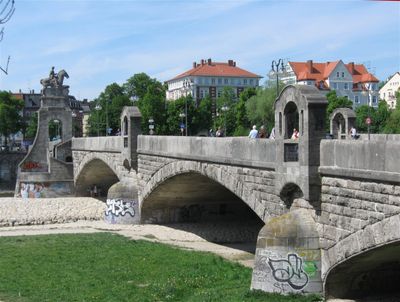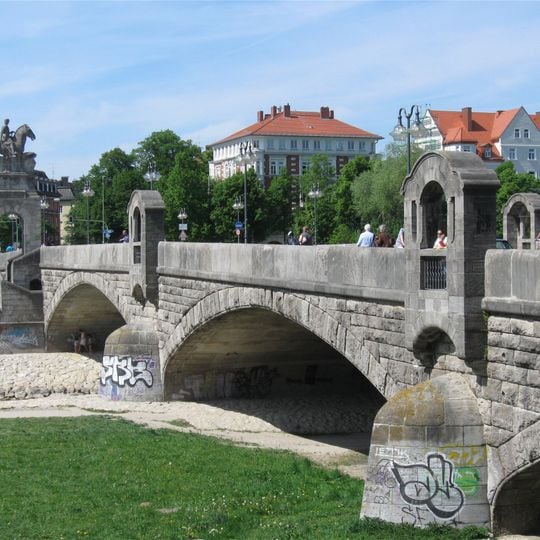
Wittelsbacherbrücke, Arch bridge in Isarvorstadt district, Munich, Germany.
The Wittelsbacherbrücke is a road bridge over the Isar in Munich, linking the Isarvorstadt district on the left bank with Au and Untergiesing on the right. Its four flat three-hinged arches of stamped concrete span 44, 28, 27 and 26 metres, and all four are clad in Muschelkalk limestone. Theodor Fischer designed the outer form, while Sager & Woerner built the structure in 1904 as a copy of the Reichenbachbrücke.
A wooden bridge built at this location in 1874 was replaced by the current concrete structure at the start of the 20th century. The construction company Sager & Woerner completed the new bridge in 1904, changing the look of this part of the city.
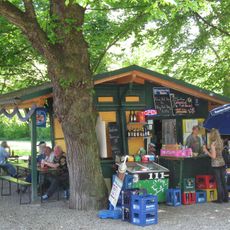
The bridge is named after the Bavarian royal house of Wittelsbach. The equestrian statue depicts Otto von Wittelsbach and was made by sculptor Georg Wrba; its pedestal forms part of a bridge pier. On the right bank at Schyrenplatz stands what its inscription calls probably Munich's oldest kiosk.
The bridge links Kapuzinerstraße in the Isarvorstadt with Humboldtstraße in the Au and Untergiesing, carrying road traffic and pedestrians. On the left bank, a symmetrical staircase beside the bridge pier leads down to a viewing platform and a room beneath the roadway. The equestrian statue of Otto von Wittelsbach stands on the pier itself.
Below the roadway there is a hidden observation space that can be reached by symmetrical staircases from both sides of the bridge. From there, visitors get an unusual view of the arches from the inside, a perspective most people who cross the bridge never see.
The community of curious travelers
AroundUs brings together thousands of curated places, local tips, and hidden gems, enriched daily by 94,036 contributors worldwide.