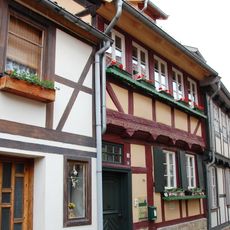
Finkenherd 1, Timber-framed heritage monument in Quedlinburg, Germany
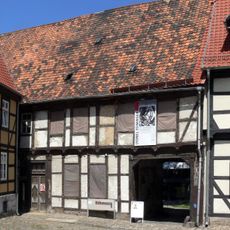
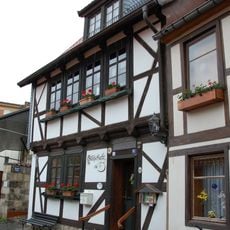
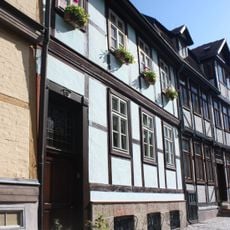
Finkenherd 1 is a small timber-framed house built after 1530, forming the northern head of the row Finkenherd 1–4 on the north side of Quedlinburg's Schlossberg. Its steep saddle roof, probably from the Baroque period, projects over the west facade into the street. The timber posts span both storeys, with braced struts and a sandstone base; the south gable is the party wall to Finkenherd 2.
The house dates from Quedlinburg's medieval settlement period and belongs to the buildings that have survived from that time. The structure was later included in the UNESCO World Heritage list, which protects Quedlinburg's outstanding collection of timber-framed buildings.
The house is named after the Finkenherd, the spot where, by legend, Duke Henry learned of his election as German king while catching birds. Since the 1980s restoration it has served the Lyonel Feininger Gallery further west as administrative and study space rather than housing, because the low ceilings limit residential use.
The house is part of the historic old town and can be viewed while walking through the downtown area. The best time to visit is in daylight so the details of the timber-frame construction are clearly visible.
The house was born in 1815 as the painter Wilhelm Steuerwaldt, and in 1983/84 the VEB Denkmalpflege renewed parts of the timber frame and replaced the mezzanine with a small gallery. The renewed floor rests on its own supports to relieve the outer walls.
The community of curious travelers
AroundUs brings together thousands of curated places, local tips, and hidden gems, enriched daily by 92,890 contributors worldwide.