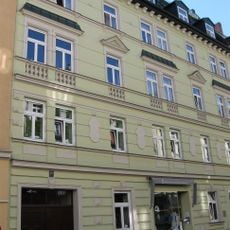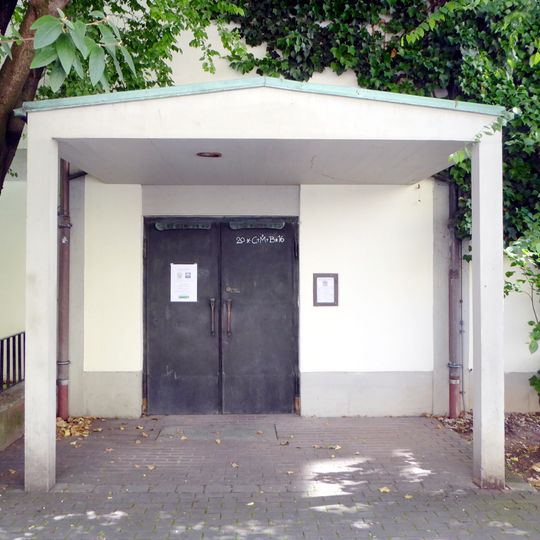
Herz-Jesu-Kloster, Catholic monastery and church in Isarvorstadt, Munich, Germany
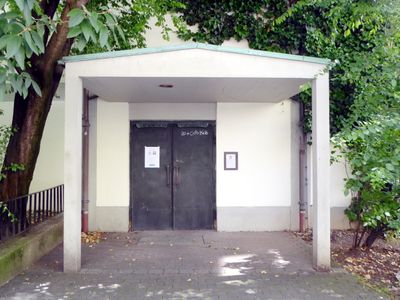
Herz-Jesu-Kloster is a monastery of the Niederbronn Sisters with its church at Buttermelcherstraße 10 in Munich's Isarvorstadt. Built 1953–1955 to designs by Alexander von Branca and Herbert Groethuysen, the church is Munich's first fully reinforced-concrete church: a three-aisled hall in exposed concrete, with the sisters' choir closed toward the nave on both sides of the altar.
A predecessor building designed by Michael Reifenstuel was erected in 1869 and destroyed by bombs in World War II. The present monastery complex, with its church and a girls' residential home, was built from 1953 to 1955 to designs by Alexander von Branca and Herbert Groethuysen. The foundation stone was laid on 16 August 1953, and the church was consecrated on 5 June 1955. It was renovated in 1995 and listed as a cultural monument in 1999.
The monastery belongs to the Niederbronn Sisters, whose convent church was consecrated on 5 June 1955. The nuns' choir, closed off toward the main nave, sits on both sides of the altar, so the sisters' liturgical space is separate from the congregational area. Three historic bronze bells hang in the bell carrier and are still rung by hand via rope pulls.
The monastery and its church stand at Buttermelcherstraße 10 in the Isarvorstadt district, not in Neuhausen-Nymphenburg. The three bronze bells in the bell carrier are still rung by hand using ropes, so ringing is tied to the sisters' daily routine rather than to fixed visiting hours. The church is a listed building, renovated in 1995.
The three bronze bells in the bell frame are rung by hand using ropes to this day; the secondary sources date them to 1540, 1717 and 1816, giving the notes g1, b1 and d2. The church itself, consecrated on 5 June 1955, was Munich's first fully reinforced-concrete church.
The community of curious travelers
AroundUs brings together thousands of curated places, local tips, and hidden gems, enriched daily by 94,638 contributors worldwide.