Teufelshöhle, Show cave in Steinau an der Strasse, Germany
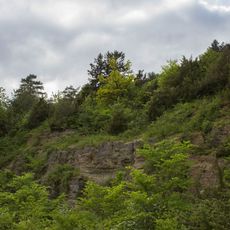
Teufelshöhle is a dripstone show cave on the slope of the Kieskopf, about three kilometres north of Steinau an der Straße. Visitors walk 174 metres through an access tunnel dug from 1905 to 1908 into three larger chambers; the Great Dome was cleared of 300 cubic metres of rubble and bones. In the Chapel, a natural cavity found during the digging, the rock is layered with horizontal ridges and folds, dark grey-brown below and greenish-grey with glittering specks above.
The cave became known in 1584 when a local shepherd reported an incident involving his cow falling into an opening. This early account marked the first documented mention of the site in written records of the region.
The name Teufelsloch arose after 1584, when cowherd Jox Mellmann and his neighbours blamed the devil for a cow lost down the shaft. Residents threw stones and dead animals in to drive him out, and farmers grew reluctant to cross the meadow. The Count of Hanau, resident at Steinau Castle, later used the hole as a dog cemetery.
The show cave is entered through a 54-metre tunnel dug between 1905 and 1908 that leads straight to the Great Dome, where a platform was levelled at the same height as the entrance gallery. The route through the three chambers runs 174 metres; the passages are underground and uneven, so sturdy footwear helps. The cave lies about three kilometres north of Steinau an der Straße on the slope of the Kieskopf.
In 1911 a skull found in the rubble was reported as a fossil human; Professor Otto zur Strassen found rust traces from nails fixing the jaw and identified it as a chimpanzee skull. A pharmacist from Steinau had treated it with chemicals and hidden it to trick excavation leader Lüders.
The community of curious travelers
AroundUs brings together thousands of curated places, local tips, and hidden gems, enriched daily by 94,019 contributors worldwide.