St. Benedict, Catholic filial church on the Domberg in Freising, Germany
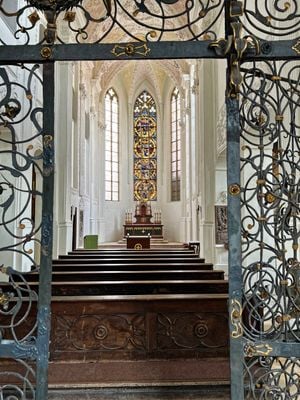
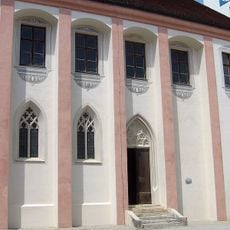
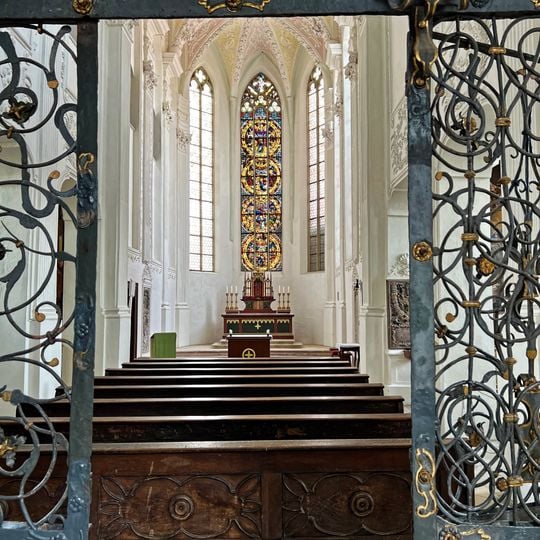
St. Benedict is a Gothic church on Cathedral Hill in Freising, built from 1347 under provost Otto von Maxlrain. Its tall interior has pointed arches, slender columns and a high vaulted ceiling, with dark wooden pews along the aisle. The choir's east window, a stained-glass work made around 1400 by Eglolf von Hornpeck, is the only survivor of the church's medieval glazing; the interior was given Baroque stucco by Nikolaus Liechtenfurtner in 1716.
A church dedicated to Saint Korbinian existed on this site in the early medieval period. The current building was begun around 1347 and received its Baroque interior decoration with frescoes and ornamental stucco work in 1716.
The church is named after Saint Benedict, whose Rule was introduced at the Freising cathedral monastery around 825, when a first church was likely built. In the 12th century it was venerated as the burial place of Bishop Korbinian, the monastery's founder. The side-aisle frescoes show the four Latin Church Fathers and the four Evangelists; the fresco of Saint Gregory was destroyed in 1839 and that of Saint John was painted over the same year.
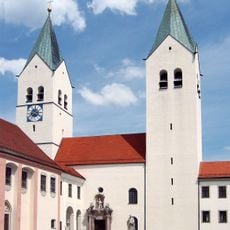
St. Benedict is reached through the cloister running through the rear of the church, east of Freising Cathedral; an iron gate from 1716 separates the two. The church is a filial church on Cathedral Hill, so access follows the cloister rather than a street entrance.
Wrought iron gates from 1716 with intricate designs separate the church from the adjacent cloister behind it. These gates reveal the close connection between the building and the larger monastic community that once thrived here.
The community of curious travelers
AroundUs brings together thousands of curated places, local tips, and hidden gems, enriched daily by 92,833 contributors worldwide.