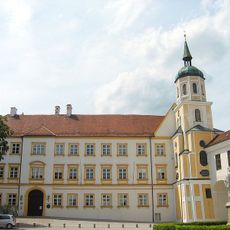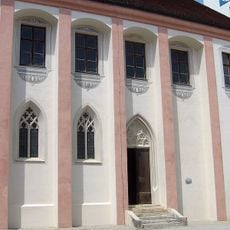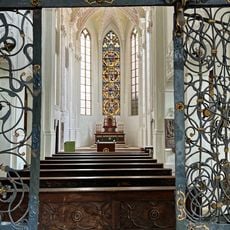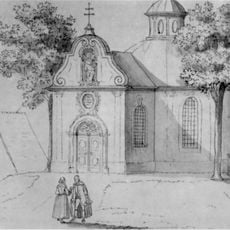
Freising Cathedral, Romanesque cathedral in Freising, Germany.
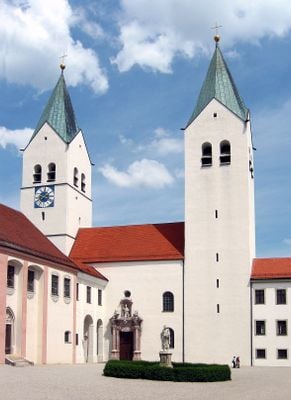
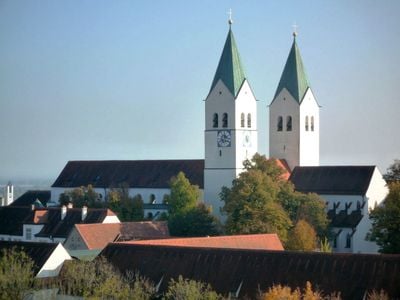
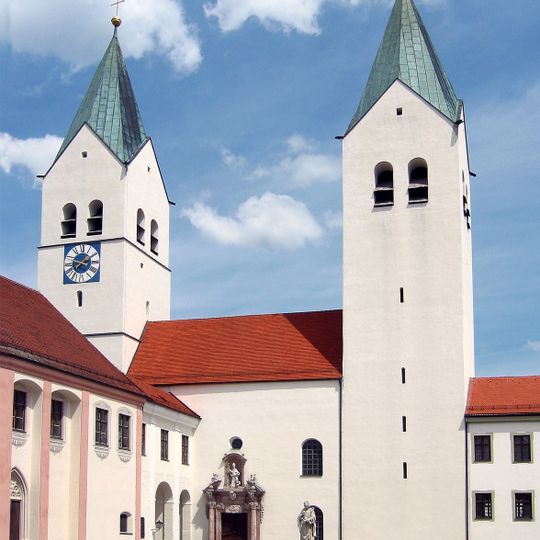
Freising Cathedral is a 78-metre-long, five-aisle Romanesque basilica with a twin-tower facade. The towers, built of brick and partly tuff, reach 56 metres and carry green pyramidal roofs; the north tower has two slight setbacks from removed Romanesque mouldings. The exterior portal of 1681 is carved from red Adnet marble and holds a niche statue of St Corbinian.
A church stood here by 715, consecrated as the bishop's seat by Boniface in 739; a triple-nave building of 860 was rebuilt after a fire in 903. The church burned on Palm Sunday, 5 April 1159, and construction of the present Romanesque basilica began the same year, with completion and consecration in 1205. A Gothic vault replaced the wooden ceiling in 1481–1483, and renovation began in 1621 under Prince-Bishop Veit Adam von Gepeckh.
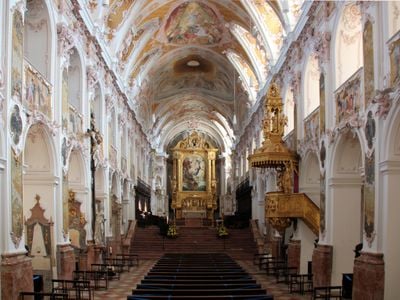
The rococo interior was created around 1724 by the brothers Cosmas Damian and Egid Quirin Asam for the church's thousand-year jubilee; they took the colours of their frescoes and stucco from Rubens's high altarpiece. The high altar itself was set up in 1625 to a design by Hans Krumpper, and its Rubens painting, the Woman of the Apocalypse, is now in the Alte Pinakothek in Munich, with a copy in the church.
The cathedral stands on the Domberg, the hill above Freising's old town, reached on foot by climbing from the town centre. The main portal opens under the three-part porch added in 1681, with the niche figure of St Corbinian. The crypt with the Bestiensäule lies below the choir, so allow time to descend.
In the four-nave crypt, the Bestiensäule stands at its centre: a High Medieval carved column, counted among Europe's most distinguished sculptures. The crypt also holds the tomb of St. Corbinian, patron saint of the bishopric and of Freising.
The community of curious travelers
AroundUs brings together thousands of curated places, local tips, and hidden gems, enriched daily by 93,118 contributors worldwide.