Weihenstephan Abbey, Benedictine monastery in Freising, Germany
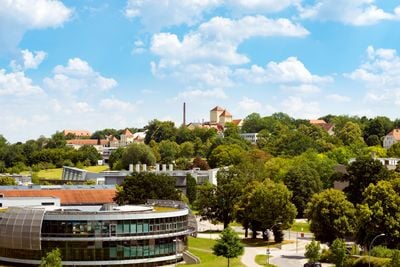
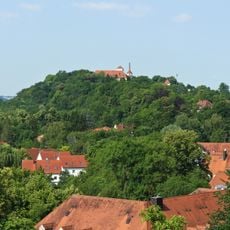
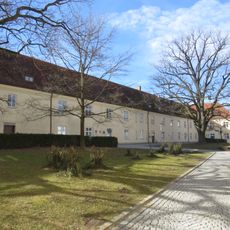
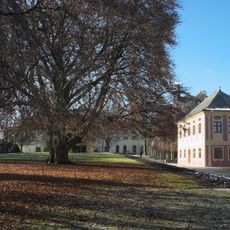
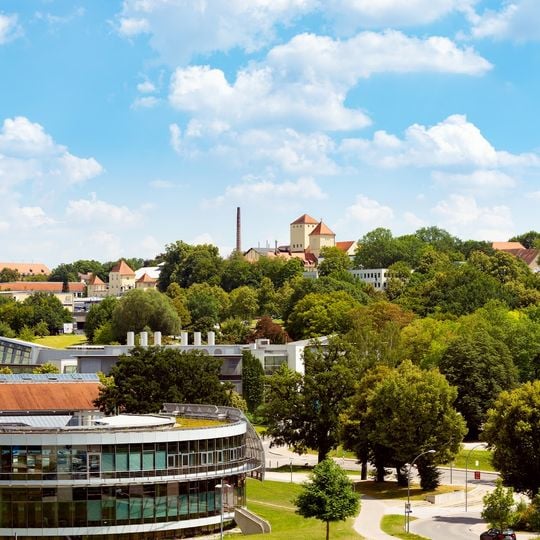
Weihenstephan Abbey is a former Benedictine monastery on a wooded hill above Freising. Its surviving west and southwest wings, now used by the Technical University of Munich, stand behind the tree canopy; the main building has a pale facade and a steep red tiled roof with small dormer windows, a slender dark square tower rises to the right, and a taller narrow structure with a steep roof adjoins on the left. The abbey church was demolished in 1810, and its ground plan is traced in the Hofgarten.
Bishop Hitto of Freising founded the monastery between 811 and 835; it was served by Augustinian canons until about 1020, when Bishop Egilbert of Moosburg replaced them with Benedictine monks from St. Kastulus in Moosburg. The abbey was dissolved in 1803 during Bavaria's secularisation, and its church was demolished in 1810. The brewery passed to the Bavarian state.
The name Weihenstephan combines the monastery's dedication to Saint Stephen with "weihen", to consecrate. The brewery's beers carry monastic names: Korbinian recalls the saint who founded the church here around 720, and Vitus the monastery's first patron. The abbey church's Gothic high altar by Jan Polack survives, though the church itself was demolished in 1810.
Visitors can explore the grounds with its buildings and brewery, often with guided tours available. Wearing comfortable shoes is recommended since the hillside terrain is uneven and stairs connect different levels.
A document from 768 records a hop garden near the abbey paying tithe to the monastery, predating the 1040 brewery licence by nearly three centuries. The brewery's strongest beers are Infinium at 10.5% ABV, Vitus at 7.7% and Korbinian at 7.4%. Weltenburg Abbey, also in Bavaria, has brewed since 1050 and disputes the record.
The community of curious travelers
AroundUs brings together thousands of curated places, local tips, and hidden gems, enriched daily by 92,854 contributors worldwide.