Schloss Sulzheim, Baroque castle in Sulzheim, Germany
Schloss Sulzheim is a three-winged baroque complex in horseshoe form with a raised central pavilion, built from 1722/23 with the shell finished by 1728 and fittings continuing to at least 1731. The side wings follow Joseph Greissing's style, while the central pavilion's proportions differ visibly from them. Near the road to Alitzheim stands the two-storey Schüttboden grain store, built 1693/94 by Johann Leonhard Dientzenhofer.
Sulzheim began as a castle-like court of the Würzburg Hofkapitel and passed to Ebrach Abbey in 1134. Under Abbot Wilhelm I. Sölner the old moated court was demolished; work on the three-winged baroque palace began in 1722 or 1723, the shell was finished by 1728 and fittings continued to at least 1731. The design is attributed to Joseph Greissing, who died in December 1721. In 1802 the palace passed to Churbaiern through secularisation, and in 1805 Bavaria ceded it to the Grand Duchy of Würzburg.
The name Sulzheim passed with the village to the Cistercian abbey of Ebrach in 1134, which held the estate as its Amtshof and had the medieval moated complex documented in a plan by Leonhard Dientzenhofer in the 1690s. The abbey's baroque rebuilding under Abbot Wilhelm I. Sölner produced the three-winged horseshoe plan with a raised central pavilion, its shell finished by 1728 and fittings worked on until at least 1731.
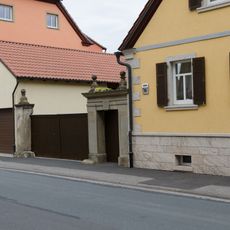
The baroque complex lies in Sulzheim, with the two-storey Schüttboden grain store standing on the road toward Alitzheim. The three-winged main building is grouped around a horseshoe-shaped courtyard with a raised central pavilion. Visitors approach the ensemble from the village street; the former fortified ring wall with its corner towers survives only in Dientzenhofer's 1690s ground plans.
Older literature long linked the castle to Balthasar Neumann, but recent research rules this out: the side wings clearly show Joseph Greissing's style, and the central pavilion is too far from Neumann's quality. Greissing died in December 1721, shortly before construction began, so the design was likely modified on site by another master.
The community of curious travelers
AroundUs brings together thousands of curated places, local tips, and hidden gems, enriched daily by 92,831 contributors worldwide.