Friedhof Norderreihe Altona, Cemetery in Altona-Altstadt, Germany.
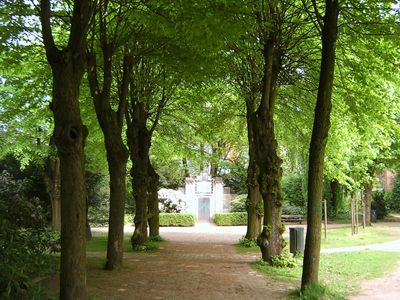
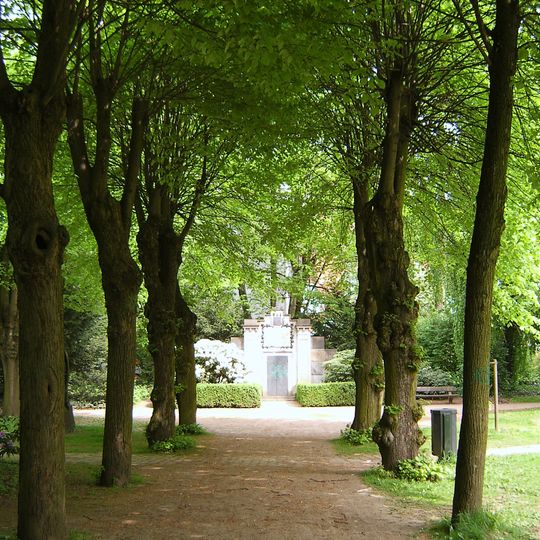
Wohlerspark, formerly Friedhof Norderreihe, is a 4.6-hectare public park in Hamburg-Altona-Altstadt between Norderreihe and Wohlers Allee. Two five-metre-wide lime avenues cross at a circular rondel about 50 metres across, with a perimeter avenue; the plan called for 330 lime trees. The southern entrance on Norderreihe had a main gate with two doors and two side entrances; a chapel built there in 1850 was demolished after the war.
The cemetery was consecrated in 1831 to relieve the Heilig-Geist-Kirchhof of St. Trinitatis parish. The church council bought two meadow plots of over 4.4 hectares from landowner Joachim Behn for 16,000 marks plus an annual annuity of 1,200 marks. The first burial, on 21 July 1831, was bank director Kiß. From 1879 no new plots were sold because 85% were already family graves; the last burial was Bertha Charlotte Reincke on 11 October 1945.
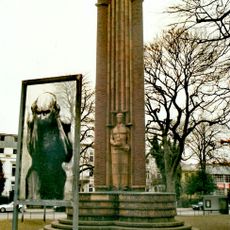
The name Wohlerspark refers to Wohlers Allee, the street bordering the former cemetery, which was consecrated in 1831 as Friedhof Norderreihe. The poet of the Schleswig-Holstein anthem, Matthäus Friedrich Chemnitz, who died impoverished in 1870, lies in a merchant's family plot near the outer avenue; his memorial column, about two and a half metres tall, was erected in 1913. Military memorials recall Altona's Danish and Prussian past, including a plot for soldiers of the Danish garrison stationed here until December 1863.
The grounds are entered from Norderreihe, where the former main portal stood and a chapel was built in 1850. Two five-metre-wide lime avenues cross at a circular rondel about 50 metres across, with a perimeter avenue around them; the Blücher tomb closes the central north-south axis. The site is a public park, not an active burial ground, and the war-era fire pond survives in the southeast corner.
The cemetery holds 46,214 burials recorded between 1831 and 1945, of which 14,152 were in vaults and crypts and 32,062 in row graves. In the last days of the war, many gravestones in the northeast section were cleared away to be used for a tank barrier in the street Bei der Johanniskirche.
The community of curious travelers
AroundUs brings together thousands of curated places, local tips, and hidden gems, enriched daily by 93,958 contributors worldwide.