Castra of Gunzenhausen, Roman military fort in Gunzenhausen, Germany.
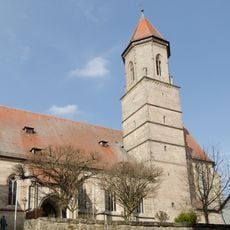
The Castra of Gunzenhausen was a Roman fort, about 86 by 80 metres (0.7 hectares), now completely overbuilt beneath Gunzenhausen's town centre. Its nearly north-south alignment is slightly off rectangular, and the Protestant parish church covers almost the entire southern part of the fortification. Nothing of the ramparts or ditches is visible today.
The fort was founded in the 2nd century as a defensive outpost along the Roman frontier. It was part of the Limes system and was eventually abandoned as Roman power in the region declined.
The fort lies entirely beneath Gunzenhausen's old town; its southern part is covered by the Protestant parish church, successor to a Benedictine monastery first mentioned in 823. The monastery of Gunzinhusir was the nucleus of the later town, so the Roman garrison site and the town's own origin occupy the same ground.
The fort lies entirely beneath Gunzenhausen's old town, so there is no rampart or ditch to walk; visible remains are limited to the spot where the south wall and headquarters were detected. The Protestant parish church covers most of the southern part of the fortification. Look for the church as the main orientation point.
In 1953, a hoard of 339 silver coins was found about 420 metres east of the fort. It was buried during a Germanic raid in 241 or 242 AD, suggesting the fort still stood or had been repaired after the first Alemannic attack in 233.
The community of curious travelers
AroundUs brings together thousands of curated places, local tips, and hidden gems, enriched daily by 92,899 contributors worldwide.