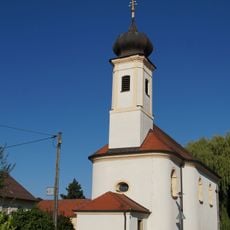
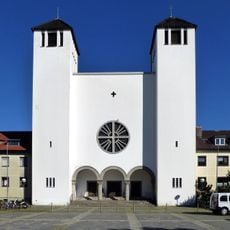
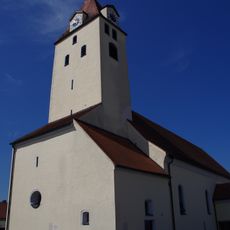
Kreuzhofkapelle, Romanesque church near Danube River in Regensburg, Germany
Kreuzhofkapelle is a Romanesque church in Regensburg built with ribbed vaults, a western gallery, and a semi-circular apse featuring round-arched windows. The interior is arranged on multiple levels with a south-facing entrance through a two-tiered round-arched doorway and a narrow staircase providing access to the upper floor.
The two-storey church was probably built by the Edlen von Barbing, a ministerial family documented from the mid-12th century. In September 1156 Frederick Barbarossa moved the Reichstag from Regensburg to the Kreuzhof to settle the dispute over the Duchy of Bavaria; the Privilegium minus, which created the Duchy of Austria, is said to have been sealed in the chapel. In 1189 Barbarossa again gathered a crusader army here, and in 1278 the Heilig Kreuz convent acquired the site, giving it its name.
The name Kreuzhof comes from the Dominican convent of Heilig Kreuz in Regensburg, which acquired the site in 1278. The church is dedicated to Saint Giles, as are the country churches of Hof and Schönfeld. The upper storey, reached by a narrow staircase in the west gable, probably sheltered pilgrims or the homeless.
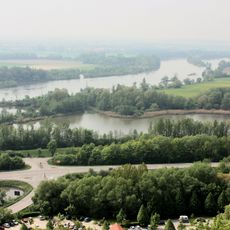
The chapel stands near the Osthafen on the south bank of the Danube, at the eastern edge of Regensburg. Entry is at ground level from the south through a stepped round-arched portal; the upper storey was reached by a narrow staircase set into the west gable wall, and the inner doorway beneath the hostia stone is walled up.
The chapel's name comes from the Heilig Kreuz Dominican convent, which acquired the Kreuzhof estate in 1278. The site's earlier history is older still: continuous settlement traces go back to the 5th millennium BC, and a larger settlement with a cemetery existed in Carolingian and Ottonian times.
The community of curious travelers
AroundUs brings together thousands of curated places, local tips, and hidden gems, enriched daily by 94,189 contributors worldwide.