Bilzingsleben, Archaeological site in Bilzingsleben, Germany
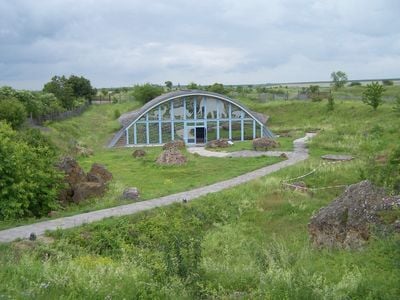
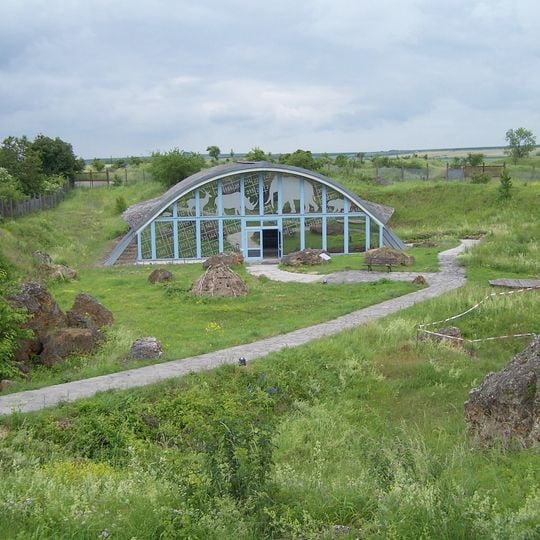
Bilzingsleben is an archaeological excavation site in Thuringia where researchers have uncovered evidence of ancient human settlement dating back hundreds of thousands of years. The site reveals multiple living areas with stone tools, bone objects, and fossil materials that tell the story of early inhabitants.
Fossil bones were noted at the Steinrinne travertine quarry since the 13th century, and in 1818 Friedrich von Schlotheim found a lime-encrusted human skull, now lost. Dietrich Mania identified fossils and artefacts in 1969, and systematic excavation ran from 1971 to 1992, documenting 1,600 m². The travertine layers date the finds to the Reinsdorf interglacial, about 370,000 years ago.
The site's name means "discovery site Bilzingsleben"; the former travertine quarry, called Steinrinne, supplied building stone for the region, including Kindelbrück's city wall. Among the finds are diminutive chopping tools, bone hoes, scrapers and points, some hoes of antler or ivory, and preserved wooden objects. An elephant tibia bears two groups of 7 and 14 incised parallel lines, possibly an early calendar.
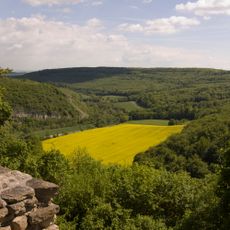
The site lies about 1.5 km south of Bilzingsleben village, on the Steinrinne spur framed by the Wipper to the east and the Wirbelbach to the south, at 175 m above sea level. The former quarry surface stands roughly 35 m above the present floodplain, so the approach climbs; the ground is an old travertine quarry, not a built path.
Among the finds is an elephant tibia bearing two groups of incised parallel lines, 7 in one and 14 in the other, cut with a single stone tool between 350,000 and 400,000 years ago. Their even spacing and V-shaped cross-sections have led researchers to suggest the marks may represent an early calendar.
The community of curious travelers
AroundUs brings together thousands of curated places, local tips, and hidden gems, enriched daily by 94,062 contributors worldwide.