Friedenskirche, Protestant church building in Handschuhsheim district, Heidelberg, Germany.
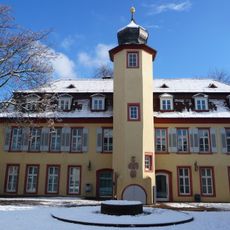
The Friedenskirche stands on a small rise behind the Tiefburg at the edge of Handschuhsheim's old village core. Its 61-metre tower is attached to the eastern corner, and the northwest facade with the main portal is flanked by two stair towers, giving the building the look of a castle complex. The style mixes late Gothic, Renaissance and Jugendstil elements; the ground plan is a Greek cross with four galleries and ribbed vaults, built as a typical preaching church following the Wiesbaden Programme.
St. Vitus Church served both Catholics and Protestants from 1650, until it was given to the Catholics in 1905. The Protestant congregation then built the Friedenskirche to Hermann Behaghel's designs; the foundation stone was laid on 14 June 1908 and the church was consecrated on 29 June 1910. The original bells were requisitioned in 1917 and replaced by cast-steel bells in 1920.
The church's interior was rearranged in 2011–2012 to restore the axial line of altar, pulpit and organ demanded by the Wiesbadener Programm; a new black bronze altar was moved to the centre, and a stepped structure behind it links the congregation to the organ gallery. That staircase proved controversial and divided the parish. The building was reconsecrated on 30 September 2012.
The building is easily accessible on foot and sits in a quiet residential neighborhood with basic parking available nearby. Visitors should check ahead about current opening times and events to plan their visit effectively.
The church's three differently designed facades result from its freestanding position on a small rise behind the Tiefburg. With its stair towers and turret-like annexes, the building recalls a castle complex, a reference to the neighbouring Tiefburg that is probably deliberate.
The community of curious travelers
AroundUs brings together thousands of curated places, local tips, and hidden gems, enriched daily by 93,584 contributors worldwide.