Kalkberghöhle, Show cave in Bad Segeberg, Germany.
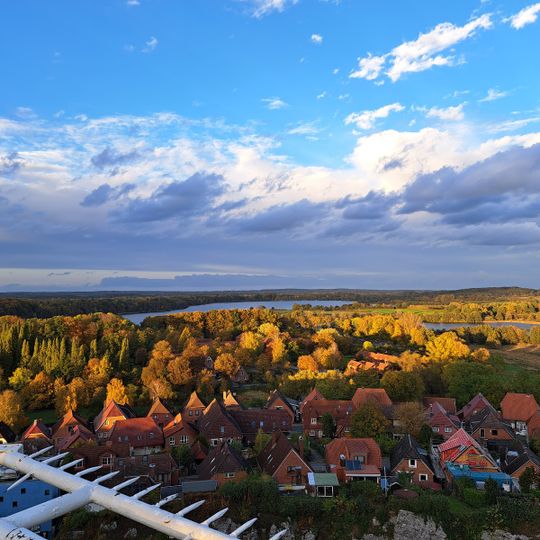
Kalkberghöhle is a show cave in Bad Segeberg, Schleswig-Holstein, running through one of the longest gypsum cave systems in Germany. The route passes through several chambers with gypsum formations visible along the walls and ceilings throughout.
Workers quarrying gypsum in the north wall broke into the cavity around 1912, but the cave was only examined on 16 March 1913 by seminarists Thode, Gripp and Bornhöft, and a fuller survey followed three days later; 1913 is thus its discovery year. It was opened to tourism and first mapped that same year. The remaining rock of the Kalkberg, including part of the cave, became a natural monument on 11 April 1942; a new protection order covering the whole cave followed on 18 September 1995.
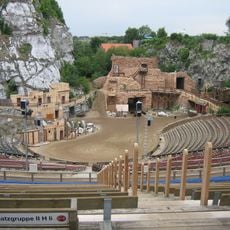
The Kalkberg's open-air stage, the Karl May Festival, is not beside the cave entrance but on the former quarry site above it, where the gypsum was once mined. Since the 1950s it has staged Karl May's Winnetou stories each summer, with the limestone rock as a backdrop.
The cave is reached through the former gypsum quarry on the Kalkberg, and the tour follows secured, lit passages; sturdy shoes help on the uneven floor. The artificial pond built in 1932/33 was removed in August 2011, when about 43 tonnes of concrete and bitumen were carried out by hand before the bats returned to their winter quarters.
A research project begun in 1991 by Schleswig-Holstein's environment ministry and the local NABU group first established the real number of bats wintering here: around 25,000. A light-barrier system counted the animals leaving the cave. The Kiel university's Faunistisch-Ökologische Arbeitsgemeinschaft now collects and evaluates the data for the state.
The community of curious travelers
AroundUs brings together thousands of curated places, local tips, and hidden gems, enriched daily by 94,481 contributors worldwide.