Frohnauer Hammer, Industrial museum in Annaberg-Buchholz, Germany.
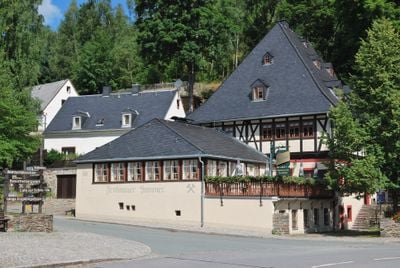
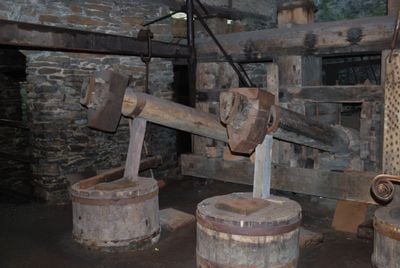
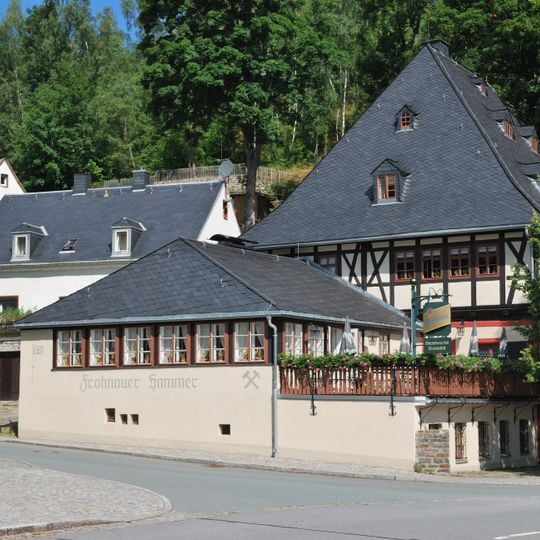
The Frohnauer Hammer is a hammer mill on the Sehma in Frohnau, now part of Annaberg-Buchholz. Its white-plastered building with a grey slate roof and wooden balcony carries the name "Frohnauer Hammer" in Gothic script between two crossed hammers. Inside, three tilt hammers with shafts driven by an overshot water wheel keep the technology of the second half of the 17th century.
The Frohnauer Hammer began as a 15th-century grain mill with four millstones. In 1496 the decision to found St. Annaberg was taken in its rooms, and in 1498 it was expanded into a mint. After falling into ruin around 1590, it was rebuilt from 1621 as a hammer mill; Gottfried Rubner converted it by 1660 to make iron strips, armour and shovels. A fire in 1692 led to the baroque Hammerherrenhaus, and the works closed in 1904.
The mill's name comes from the village of Frohnau on the Sehma. In 1935 Max Günther presented designs for an Ore Mountains festive and Sunday costume at the hammer. The complex also holds a mechanical Christmas hill and a bobbin lace room, and the Hammerherrenhaus serves as a guest house.
The complex sits by the Sehma in Frohnau, with the hammer forge and the timber-framed Hammerherrenhaus side by side; the three tilt hammers are driven by an overshot water wheel. The site is a stop on the Montanregion Erzgebirge/Krušnohoří UNESCO World Heritage route, so allow time for both the forge and the mansion rooms.
This was one of the first technical heritage sites in Saxony to be deliberately preserved as a museum. The collection includes metalworking tools and techniques that vanished from the region after production stopped.
The community of curious travelers
AroundUs brings together thousands of curated places, local tips, and hidden gems, enriched daily by 94,176 contributors worldwide.