Langenrader Windmühle, Historic Dutch windmill in Ascheberg, Germany
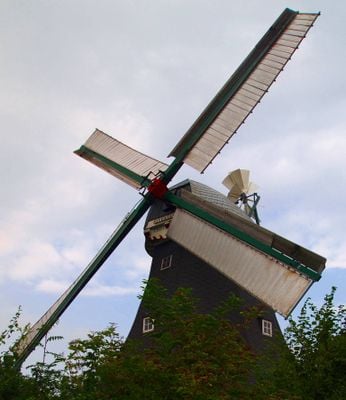
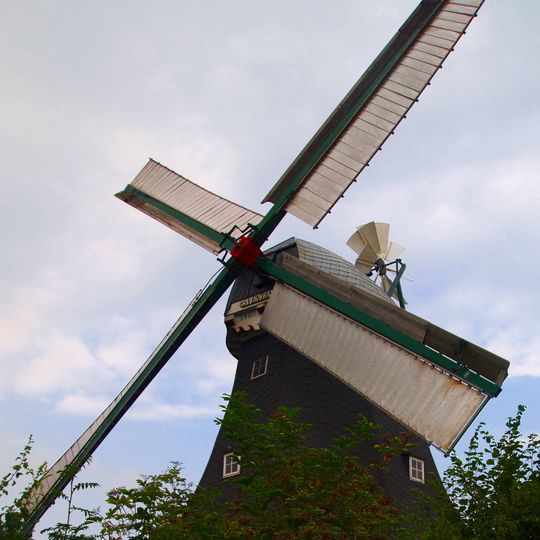
Langenrader Windmühle is a four-story gallery Dutch mill: an octagonal brick base carries a slate-covered roof and a metal-capped cap, with an external gallery at the upper level. Its sails are jalouise shutters, and a wind rose turns the cap into the wind. The mill stands on raised ground north of Langenrade in the municipality of Ascheberg.
The mill was built in 1859/60 by millwright Carl Friedrich Trahn of Neustadt in Holstein for the miller Meyer in Kleinmühlen, southeast of Plön, as a ground-sail Dutch mill with canvas-covered sails steered by a tail pole. In 1890 the miller Wittgrefe bought it, had it dismantled and rebuilt about 10 km away in Langenrade, replacing a predecessor that had burned down. The move gave it a raised brick base, a gallery, patent sails and a fantail; from 1903 machinery could drive it when the wind failed.
The mill is called Sventana, a name given in 1985 after the Wagrian word for "the Holy" for the Schwentine river flowing through the nearby Kleiner Plöner See. Since 1991 it has been protected as a technical monument, and in 2012 owner Uwe Karstens received the German Prize for Monument Protection.
The mill is open for visits and still grinds grain; flour from the mill is sold on site. The gallery was renewed in 1997, and the mill is a technical monument, so some areas may be narrow. It stands on elevated ground north of Langenrade and south of Karpe, visible from the surrounding area.
The mill has three separate milling systems designed for different grain processing tasks. This technical setup allows the production of multiple flour types within a single facility.
The community of curious travelers
AroundUs brings together thousands of curated places, local tips, and hidden gems, enriched daily by 94,637 contributors worldwide.