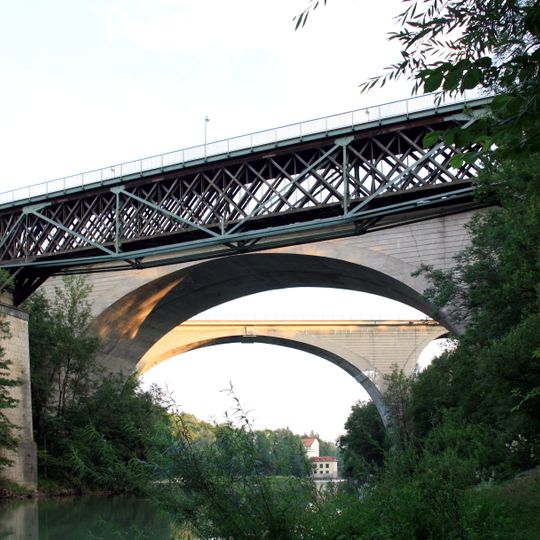
King Louis Bridge, Wooden footbridge in Kempten, Germany.
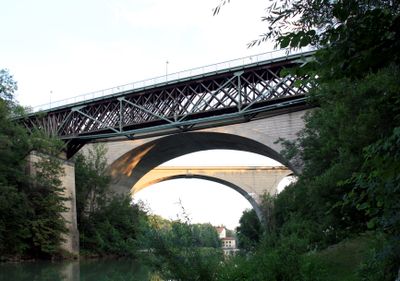
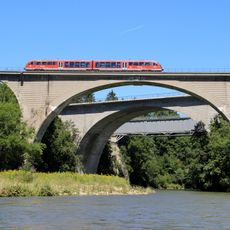
The King Louis Bridge (König-Ludwig-Brücke) is a wooden footbridge and cycle crossing over the Iller in Kempten. It has three spans of 35, 52 and 26 metres, carried by two parallel Howe truss superstructures of Swiss larch and oiled oak, with iron hanger rods. The trusses rest on two roughly 25-metre-high Nagelfluh piers and two stone abutments.
Built in 1851 for the Royal Bavarian State Railways, it originally served trains crossing the Iller valley. By 1905, increased locomotive weights made it unsuitable for rail use, leading to its conversion into a path for pedestrians and cyclists.
The bridge's current name, King Louis Bridge, dates only from 1988; the conservation authorities officially list it as Iller Bridge I. It is named after King Ludwig I, not Ludwig II, in reference to the Ludwig South-North Railway for which it was built. Since 1970 it has served pedestrians and cyclists.
The bridge is easy to access and well-positioned for pedestrians and cyclists traveling through Kempten. Be aware that the wooden surface can be slippery in wet conditions, and the width is narrow if you encounter larger groups moving in the opposite direction.
The bridge is the only surviving Howe truss bridge in Germany and, by length, the longest ever built in that system — possibly worldwide. Its hanger rods were made by BHS in Sonthofen, and their diameters taper from five centimetres near the bearings to four at mid-span, matching calculations by Karl Culmann.
The community of curious travelers
AroundUs brings together thousands of curated places, local tips, and hidden gems, enriched daily by 94,389 contributors worldwide.