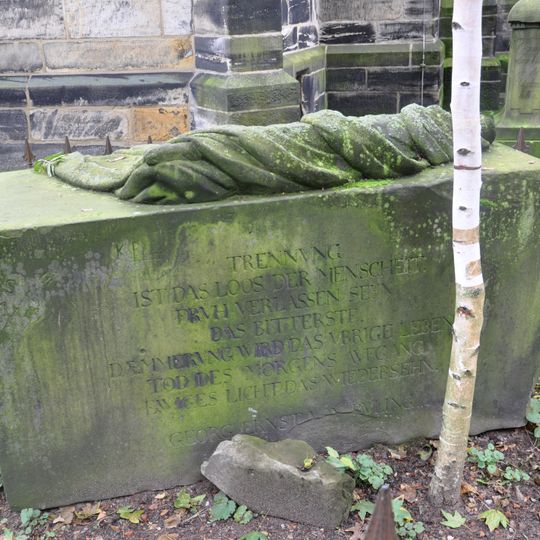
Open Grave, Tomb in Gartenfriedhof, Mitte district of Hanover, Germany.
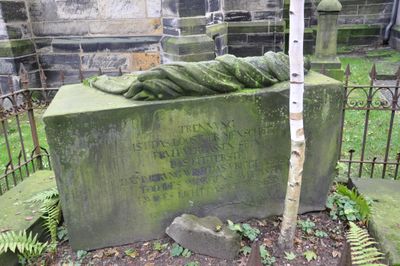
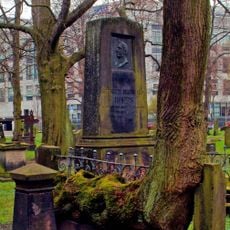
The Open Grave is a burial site in the Gartenfriedhof cemetery in Hanover with a distinctive architectural form: a heavy stone slab has been lifted by natural forces and no longer sits flat on the grave. A visible gap between the base and the cover stone reveals this unusual condition.
The tomb of Henriette Juliane Caroline von Rüling (1756–1782), wife of Hanoverian state secretary Georg Ernst von Rüling, was laid out in the Gartenfriedhof in the 1780s. Its inscription reads that the burial, bought for eternity, may never be opened. A birch later grew against the plinth and lifted the heavy slab, opening the grave; by the 19th century it was told of in horror stories, and Otto Warbeck's 1883 novel Das geöffnete Grab took the story as its premise.
The grave's fame grew in the 19th century, when it was told among horror stories of opened graves and became one of Hanover's early tourist attractions. Around 1900 it appeared on numerous postcards, and Karl Friedrich Wunder published a photograph of it in his 1905 volume of 26 artistic views of the city.
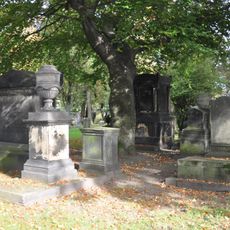
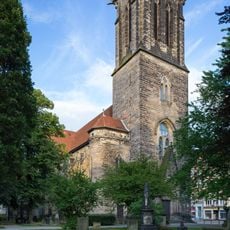
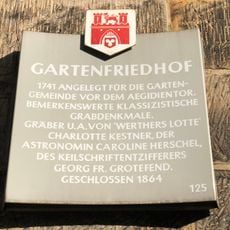
The grave stands in the Gartenfriedhof in the Warmbüchenviertel, a short walk from Aegidientorplatz. The cemetery is entered on foot; the tomb lies among the older graves, so allow time to walk the grounds and locate it. A young birch was replanted beside the stone after the 2010 felling.
A birch tree growing on the grave has lifted the heavy stone slab through its natural growth force, thus opening the tomb. This contradicts the inscription that explicitly demands the grave should never be opened.
The community of curious travelers
AroundUs brings together thousands of curated places, local tips, and hidden gems, enriched daily by 92,862 contributors worldwide.