Schloss Mattsies, Medieval château in Tussenhausen, Germany.
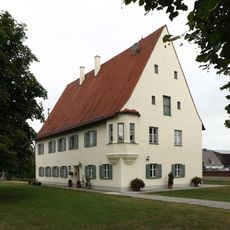
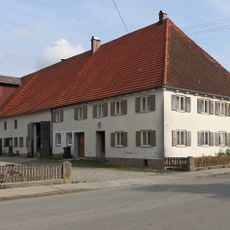
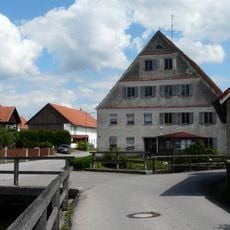
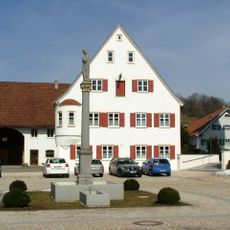
Schloss Mattsies is a castle complex in Tussenhausen defined by its five-story residential tower from the 16th century. This tower was built using tuff stone and is topped with a steep cross-gabled roof.
Built between 1202 and 1220 as a high castle for the Mazzensiez family, it was first mentioned in 1246 and served as the seat of the Marshals of Mattsies from about 1270/1280 until the mid-14th century. Emperor Frederick III ordered it burned in 1456, and rebellious peasants destroyed it again in 1525. Christoph Fugger acquired it in 1598; after 1679 it passed to Duke Maximilian Philipp and later to the Bavarian electors.
The castle's name comes from the medieval Mazzensiez family, whose high castle stood here from 1202 to 1220. The southwest annex, added around 1905 under Baron Walter von Rougemont, carries his family coat of arms in the cross-vaulted entrance hall. The two upper floors of this Neo-Renaissance wing have wooden loggias.
The castle is located at Schloßstraße 2 and can be viewed from the outside, though it is currently undergoing restoration. Visitors should note that the interior is not accessible at this time, so only the exterior architecture can be observed.
The northeast quarter of the castle began as a free-standing tower, later folded into the complex, probably in the 13th century. Its dividing wall was over a metre thick, rose to the fourth storey, was built of tuff at the base and had walled-up firing niches: four on the gable side, six on the long side. The 1905 staircase makes this hard to see today.
The community of curious travelers
AroundUs brings together thousands of curated places, local tips, and hidden gems, enriched daily by 93,597 contributors worldwide.