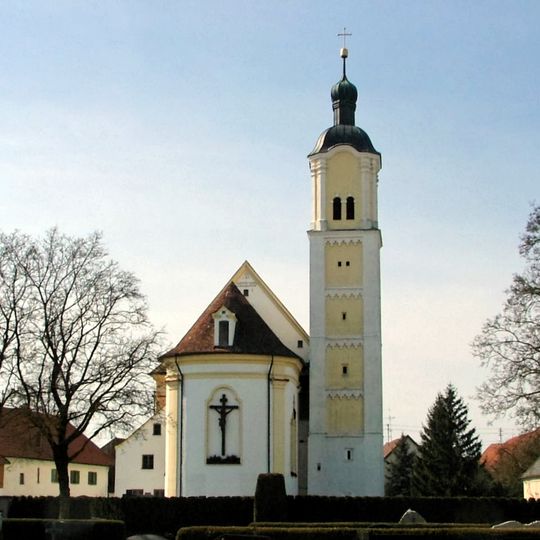
St. Magnus, Catholic parish church in Rammingen, Germany
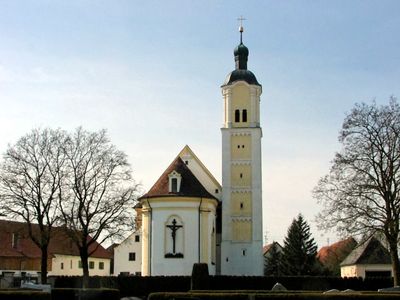
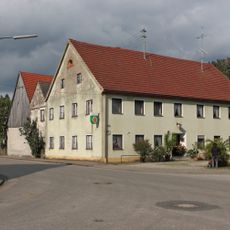
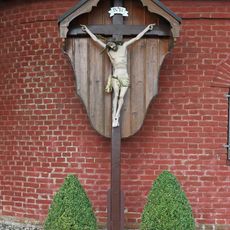
St. Magnus is a white and pale yellow Catholic parish church in Unterrammingen, set back from the main street among farmhouses. Its lower section has a curved white wall with a dark crucifix in a recessed arched niche; a brown pitched roof with a small dormer sits above. To the right rises a tall square tower with white horizontal bands, four levels of narrow openings, dark double windows, a green onion dome and a cross.
The parish was restored in 1565 after the dissolution of the Mattsies early-mass foundation, and the benefice passed to the Fuggers in 1598. The medieval church had become dilapidated, so in 1761 pastor Joseph Anton Germiller petitioned Munich for a rebuild. Court architect Ignaz Prechler drew the plans, and 25,000 bricks from the demolished Angelberg castle went into the new church, built 1767–1768 for 5,581 gulden and 20 kreuzer. Consecration followed only in 1818.
The church is dedicated to Saint Magnus, whose veneration shaped the parish's identity since the Middle Ages. The high altar painting of the saint, made in 1732 by Joseph Anton Hafner of Türkheim, is considered lost. The parish belongs today to the Mattsies parish community, and the church is known above all for its 18th-century baroque furnishings.
The walled churchyard lies slightly back from the main street among farmhouses, with the cemetery on the east side. The church is oriented to the east and the massive tower stands at the choir flank. Access to the interior depends on the parish community of Mattsies, so ask locally before planning a visit.
The 1775 organ case is counted among the finest in Swabia. The church's baroque furnishings mostly date from the 18th century, and the high altarpiece of Saint Magnus painted in 1732 by Joseph Anton Hafner of Türkheim is considered lost.
The community of curious travelers
AroundUs brings together thousands of curated places, local tips, and hidden gems, enriched daily by 94,220 contributors worldwide.