Schloss Hohenheim, Rococo château in Stuttgart, Germany
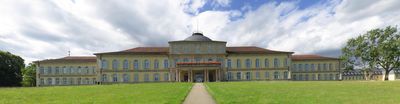
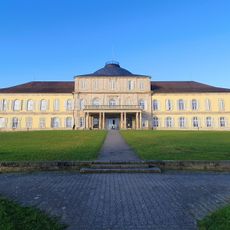
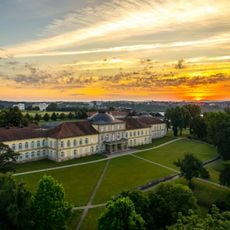
Schloss Hohenheim is a Rococo palace in Stuttgart with three inner courtyards arranged around a central axis in a symmetrical design. The complex stands as one of the largest palace structures east of the Rhine and is partly used by Hohenheim University today.
The estate came into the possession of Duke Carl Eugen of Württemberg in 1768, when the last heir of the von Garb family died without successors. From 1772 he had it rebuilt as a Rococo manor, and in 1776 it was declared his summer residence. Construction of a larger residential palace began in 1782 and stopped with the duke's death at Hohenheim in 1793.
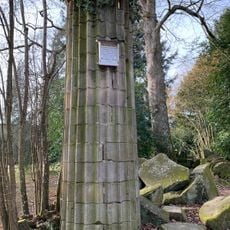
The estate's name comes from the von Hohenheim family, whose most famous member, Theophrastus Bombastus von Hohenheim, is known as Paracelsus. The Paracelsus School, founded in 1829 for the children of professors and officials, was later housed in the east wing until it moved out in 1966. Three miniature buildings from Carl Eugen's 'English Village' survive in the Exotic Garden, including the Roman Inn and the Playhouse, now a museum on the university's history.
Visitors can see the state rooms during concerts, lectures, and guided tours that happen regularly throughout the year. It is worth checking in advance when these events are scheduled, since most areas are normally reserved for university use.
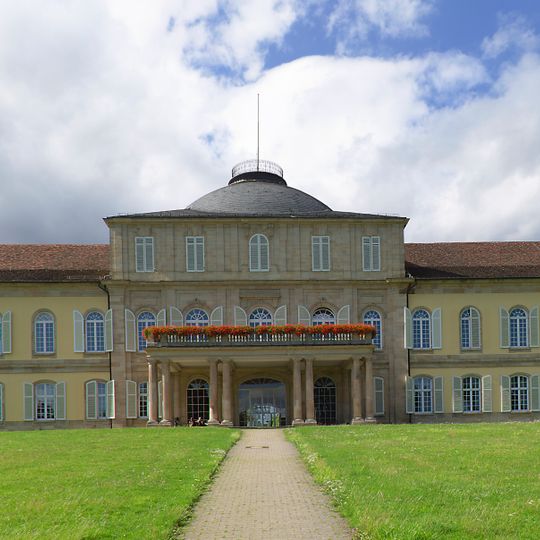
The central block's balcony rests on four columns, with orange flowers along its rail; below it, a glazed entrance is flanked by two arched windows. The three-storey building has a curved dark roof topped by a small circular railing, and its wings carry tall windows with white shutters.
The community of curious travelers
AroundUs brings together thousands of curated places, local tips, and hidden gems, enriched daily by 93,095 contributors worldwide.