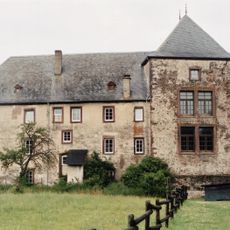
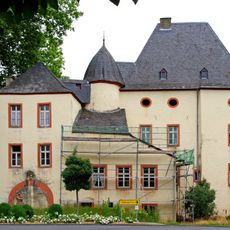
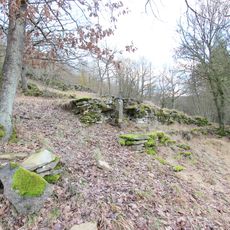
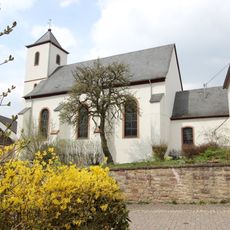
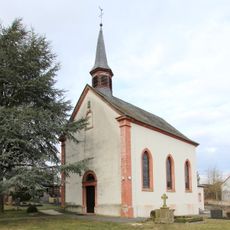
Kyllburg, Medieval castle ruin in Kyllburg, Germany.
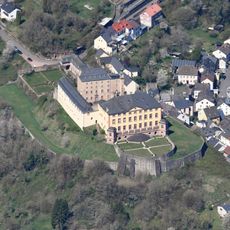
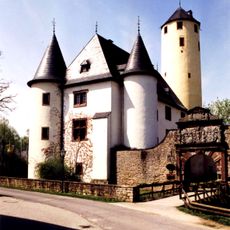
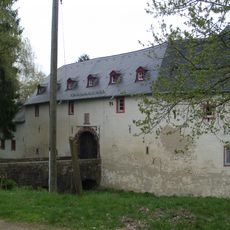
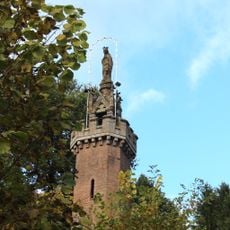
Kyllburg is a partly preserved hilltop castle on the Kyllberg above the town of Kyllburg. Its square five-storey bergfried, built from the founding period, stands over 23 metres high and is fully preserved, with an observation platform on its south side. The palas against the eastern ring wall was rebuilt at the end of the 16th century; the castle is in private ownership.
Archbishop Theoderich of Trier began building Kyllburg in 1239 to defend the Trier diocese against the lords of Malberg. To fund it, he sold the Roßporten fiefs, which had reverted to him after Agnes von Malberg's death, to St. Thomas Abbey for 200 pounds. In 1256 his successor Arnold II enclosed the castle and adjacent houses with a wall, agreeing with Abbot Jofrid of Prüm on 16 August 1256 on mutual fortifications.
The castle gave the town its name: Kyllburg combines the river name Kyll with Burg, castle. The former torture chamber of the Kyllburg high court is said to have been located beneath the schoolhouse built between the keep and the street around 1840. The site is now privately owned.
The castle is in private ownership, so the grounds and the five-storey bergfried with its viewing platform on the south side are not open to the public. The tower, over 23 m high, is best seen from the town below on the Kyllberg.
Under the former schoolhouse, built around 1840 in the old stables between the bergfried and the street, lay the torture chamber of the Kyllburg high court. It is said to have been used in the witch trials of the late Middle Ages. The castle has been in private ownership since the 20th century.
The community of curious travelers
AroundUs brings together thousands of curated places, local tips, and hidden gems, enriched daily by 94,354 contributors worldwide.