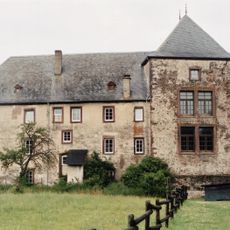
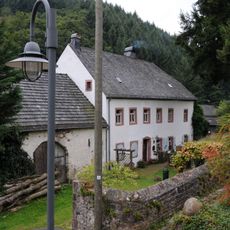
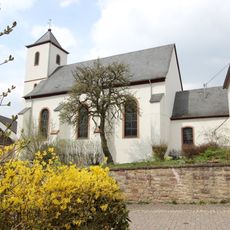
Burg Seinsfeld, Lowland castle in Seinsfeld, Germany.
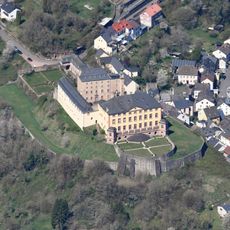
Burg Seinsfeld is a water castle on a 440-metre-high site north of Seinsfeld, its near-circular 60-metre-diameter core ringed by a moat up to 17 metres wide and 6 metres deep with an outer rampart. The north side keeps 2.50-metre-thick outer walls with arched niches, and the east side shows the abutments of a former drawbridge, now a stone bridge.
Seinsfeld Castle was first documented in 1325, when King John of Bohemia enfeoffed Arnold of Blankenheim with it. The oldest surviving building remains date from the 15th century, with major rebuilding in the 17th and 18th centuries. In 1794 Baron Ernst von Berg sold it to notary Lothar München of Dudeldorf; from 1817 the owners Carl Leist and Heinrich Carl Hellermann gave it the name Schloss Hellermannsfeld. The west wing was demolished in 1890 and rebuilt around 1935 and in 1949; after World War II it served as a children's convalescent home.
The castle's second name, Schloss Hellermannsfeld, comes from Heinrich Carl Hellermann of Meisenheim, who owned it with Carl Leist from 1817. Two gravestones are set into the stair tower in the inner courtyard, and on the east side the slots of the former drawbridge are still visible, now replaced by a stone bridge.
The property is privately owned and can only be viewed from designated spots outside the grounds. The clearest views of the exterior walls and moat are from open areas surrounding the property.
The structure uses a traditional water defense system through its moat, a method that was typical for Germanic lowland castles. This feature shows how builders used the region's natural water conditions as part of their defense design.
The community of curious travelers
AroundUs brings together thousands of curated places, local tips, and hidden gems, enriched daily by 94,420 contributors worldwide.