St. Mang's Abbey, Benedictine monastery in Füssen, Germany
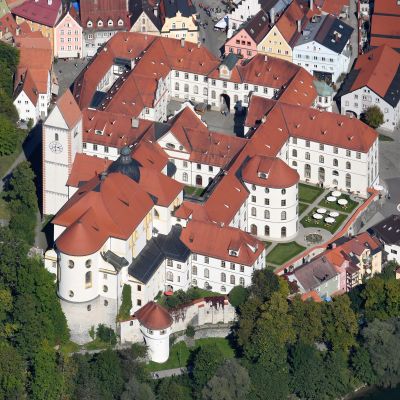
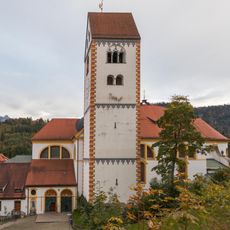
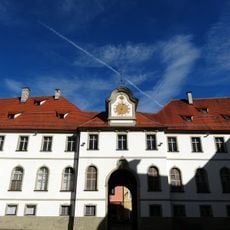
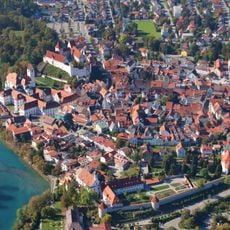
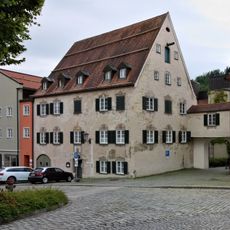
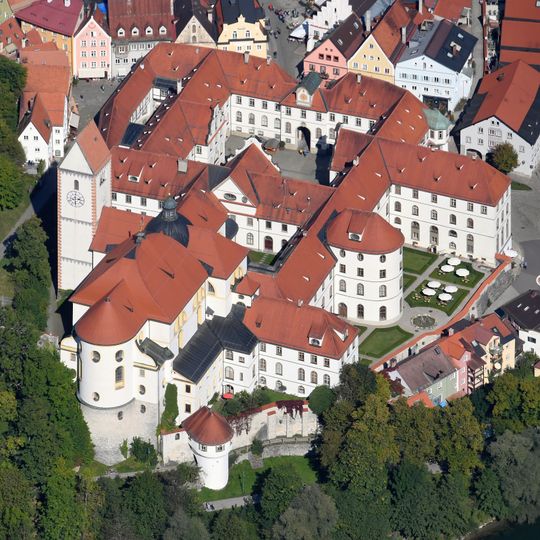
St. Mang's Abbey is a former Benedictine monastery in Füssen whose Baroque complex, built between 1696 and 1726 to designs by Johann Jakob Herkomer, has white walls and red tiled roofs around inner courtyards. A tall square white tower with a clock face and steep red pyramidal roof stands at the left, a wing with a rounded red-domed corner section at the lower left, and a small round tower with a conical red roof at the lower edge.
Founded in the first half of the 9th century as a proprietary monastery of the Prince-Bishops of Augsburg, the abbey grew from the cell and oratory of the hermit Magnus of Füssen, who died there on 6 September. Between 1696 and 1726 Abbot Gerhard Oberleitner had the medieval complex rebuilt as a Baroque monastery designed by Johann Jakob Herkomer. On 15 January 1803 Princess Wilhelmine of Oettingen-Wallerstein ordered Abbot Aemilian Hafner to dissolve the convent, and the buildings were vacated by 1 March 1803.
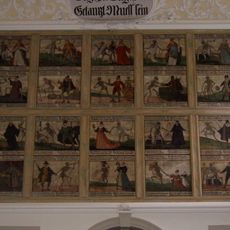
The church is a monumental reliquary of Saint Magnus, whose legend supplies the fresco cycle covering the whole interior — the first time in South German Baroque that a local saint's life set the programme. Magnus died here on 6 September; his body was found uncorrupted. Franz Xaver Seelos, beatified in 2000, was baptised in this church in 1819.
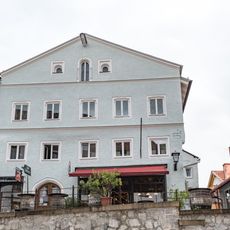
The complex is split between two owners: the former abbey church, given to the parish of Füssen in 1837, and the former monastic buildings, bought by the town in 1909. The north wing holds the town hall and the south wing the Füssen Town Museum, where the Baroque reception rooms can be visited. The church and museum are entered separately.
The abbey library's contents were carted off down the Lech on rafts after the 1803 dissolution; most volumes ended up in the University of Augsburg library, while a small group of valuable manuscripts went to the Augsburg Diocesan Archives.
The community of curious travelers
AroundUs brings together thousands of curated places, local tips, and hidden gems, enriched daily by 93,014 contributors worldwide.