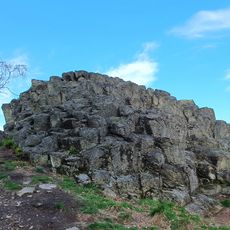
Großer Stein, Natural monument mountain in Leutersdorf, Germany.
Großer Stein is a 471-metre mountain in the East Lusatian Highlands, in the municipality of Leutersdorf. It has two rocky summits: the larger one holds a summit register, while the smaller is called Goethekopf because its silhouette resembles Goethe's facial profile. The east slope is basalt, the north slope ash tuff, and phonolite plates cap the top.
In 1928 the mountain was to be quarried for building stone; the municipality of Spitzkunnersdorf and the Landesverein Sächsischer Heimatschutz bought it instead. The area was placed under nature protection and the rock formations declared a geological natural monument, now among the protected monuments of the Görlitz district.
The smaller of the two rock summits is called Goethekopf because its silhouette resembles Goethe's facial profile. In the early 1960s a lightning strike blew off its "nose", which local heritage enthusiasts soon cemented back in place. At the foot of the rocks, the Emma-Bank looks west and the Lausche-Blick looks south.
The summit has two rock tops; the smaller one, the Goethekopf, is reached on foot and its silhouette resembles Goethe's profile. A summit book lies on the higher top for entries. At the foot of the rocks, the Emma-Bank gives a view west and the Lausche-Blick a view south.
The smaller of the two rock summits is called Goethekopf because its silhouette resembles Goethe's facial profile. In the early 1960s a lightning strike blew off its "nose", which local heritage enthusiasts soon cemented back in place. At the foot of the rocks, the Emma-Bank looks west and the Lausche-Blick looks south.
The community of curious travelers
AroundUs brings together thousands of curated places, local tips, and hidden gems, enriched daily by 92,850 contributors worldwide.