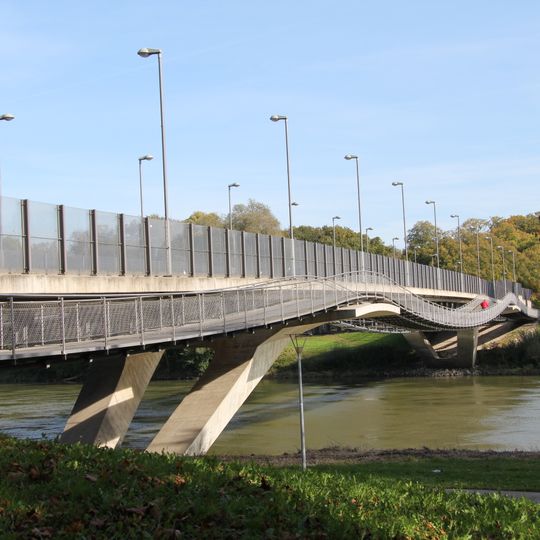
Glacisbrücke, Road bridge in Ingolstadt, Germany.
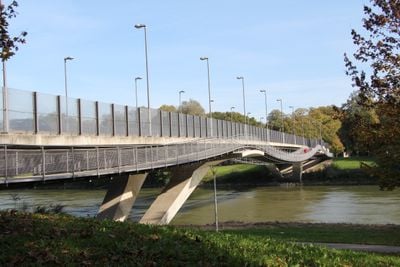
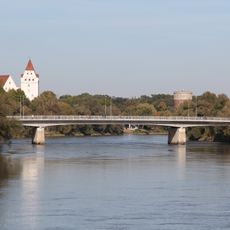
The Glacis Bridge is a 164-metre road bridge in Ingolstadt, the westernmost of the city's road bridges and part of the Ringstrasse system and Bundesstraße 13. Its 12-metre-wide deck is a two-web plate-beam section 70 centimetres deep, spanning 42 and 46 metres in the side fields and 76 metres in the centre, supported by cable under-tensioning of two times four cables, each 118 millimetres in diameter. Structurally it is a reinforced-concrete Sprengwerk with cable under-tensioning; the foot and cycle paths run alongside below the roadway on stress-ribbon bridges whose gradient follows the cables' curve. It was designed by Schlaich Bergermann Partner and Ackermann und Partner with Johann Grad and Obermeyer Planen + Beraten.
Construction began in 1996 and was completed in 1998, adding an important link to Ingolstadt's transportation system. It was built to handle increasing traffic crossing the Danube.
The bridge takes its name from military architecture, where a glacis refers to an artificial slope built in front of a fortification. The name reflects Ingolstadt's past as a fortified town.
The bridge carries traffic on Bundesstraße 13, providing a direct crossing over the Danube for vehicles moving between different city areas. It handles two-way traffic and is accessible to regular car traffic.
The bridge's structure is a reinforced concrete Sprengwerk (strut frame) with cable underspacing: two sets of four cables, each 118 mm in diameter, support the deck. Its pedestrian and cycle paths run below the roadway on stress-ribbon bridges whose profile rises and falls with the cable line. The design by Schlaich Bergermann Partner and Ackermann und Partner won the 1998 Ingenieurbaupreis and a 1999 BDA-Preis Bayern.
The community of curious travelers
AroundUs brings together thousands of curated places, local tips, and hidden gems, enriched daily by 93,770 contributors worldwide.