Keltenmuseum Manching, Celtic and Roman museum in Manching, Germany.
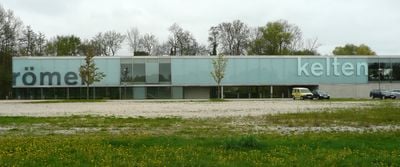
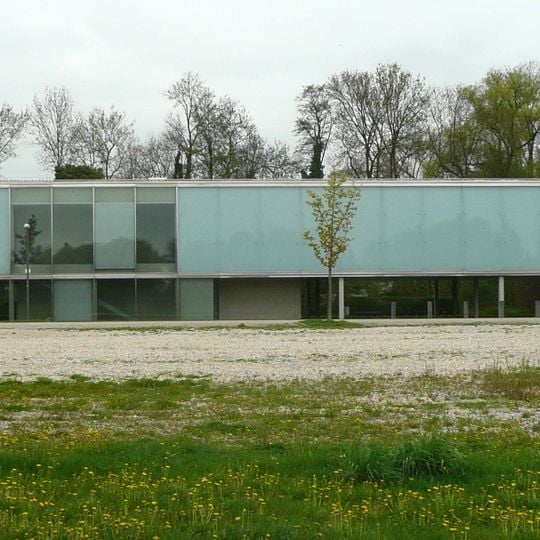
Kelten-Römer-Museum Manching is a single-storey building with a flat roof and pale metal fascia, its facade split into a band of pale blue-green translucent glass panels above a recessed strip of clear glass behind grey columns. Inside, the Celtic department occupies 670 m² and the Roman exhibition 510 m². It was designed by Fischer Architekten of Munich and opened on 2 June 2006.
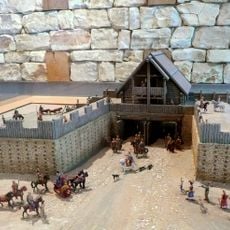
The Celtic oppidum at Manching flourished from the 3rd century BCE and peaked around 130 BCE, when its murus gallicus wall stood; it was abandoned in the second half of the 1st century BCE. Around 100 CE the Romans built a fort at Oberstimm for 500 to 600 soldiers, and two 15-metre military ships were found there in 1986. The museum opened on 2 June 2006 as a branch of the Archaeological State Collection Munich.
The Celtic section is named after the Oppidum of Manching, whose 483 gold coins (shell staters), found in 1999, were the largest Celtic gold find of the 20th century; they were stolen in a break-in on 22 November 2022. The gilded "Cult Tree" found in 1984, a branch with leaves, buds and fruits from the 3rd century BC, is described as unique worldwide. The Roman section centres on two 15-metre military ships from around 100 AD, recovered in 1994 from the silted Brautlach near Oberstimm.
The museum is easily reached on foot from Manching's town center and offers plenty of space to walk through and view the exhibits. It makes sense to allow at least two hours for a visit to explore the different sections at a relaxed pace.
The two 15-metre Roman warships found in 1986 in the silted Brautlach arm near the Oberstimm fort were raised in 1994 and restored in Mainz. A Hamburg shipyard built a working copy in mortise-and-tenon technique; tests reached about 14 km/h.
The community of curious travelers
AroundUs brings together thousands of curated places, local tips, and hidden gems, enriched daily by 93,875 contributors worldwide.