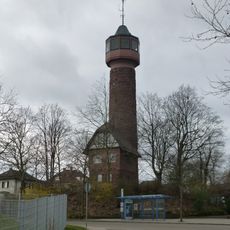
Matthäuskirche, Modern church building in Pforzheim, Germany.
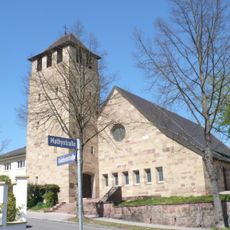
Matthäuskirche is a church building in Pforzheim made from concrete with clean geometric forms and minimalist design. The structure features simple lines and spacious interior volumes that create an open, straightforward spatial experience.
Egon Eiermann designed the church, built from 1951 to 1953 with Helmut Striffler and consecrated on 12 July 1953; the tower followed in 1956. It was Germany's first exposed-concrete church after the war, and its honeycomb windows, made with rubble aggregate, became a model for the Kaiser-Wilhelm-Gedächtniskirche in Berlin.
The church is in the Arlinger district, at the edge of the Gartenstadt, Hochkopfstraße 30. Its honeycomb windows were designed by glass artist Hans Theo Baumann, who also proposed the use of shaped blocks; he made the first altar cross and baptismal bowl in thick glass. The colouring varies because Egon Eiermann had rubble gravel from Pforzheim's war destruction added as aggregate.
The church stands at Hochkopfstraße 30 on the edge of the Gartenstadt in the Arlinger district, not in the city centre. The forecourt, once a lawn with stepping stones and trees, has been paved since the early 1970s. The interior is the part protected as a monument, so visits focus on the hall rather than the tower.
The honeycomb window blocks contain crushed rubble from Pforzheim's wartime destruction, added as aggregate at Egon Eiermann's instruction, so the coloured glass literally holds the debris of the bombed city. The first altar cross and baptismal bowl, both in thick glass, came from glass artist Hans Theo Baumann, who also proposed using the shaped blocks.
The community of curious travelers
AroundUs brings together thousands of curated places, local tips, and hidden gems, enriched daily by 94,600 contributors worldwide.