Göring-Kahn, wooden barge wreck in Brandenburg, Germany
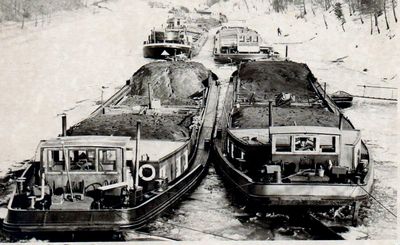
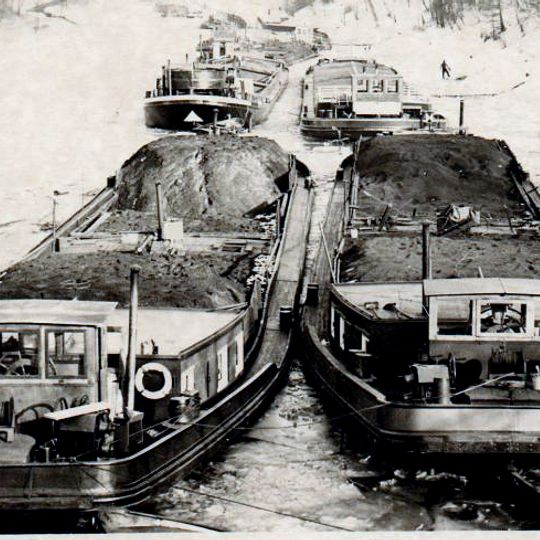
The Göring-Kahn is a wooden inland cargo barge approximately 55 meters long and 8.2 meters wide, built to carry loads up to 600 tons across rivers and canals. The vessel features a reinforced bow designed to break through ice and displays the sturdy construction needed for freight transport in difficult conditions.
Ten wooden barges of this type were built in Uddevalla, Sweden, from the early 1940s on behalf of the Reichswerke AG für Binnenschiffahrt "Hermann Göring". Five were lost in World War II; four remained in service with the Kanal-Verkehr AG until 1950. The wreck near Hennigsdorf was used after 1945 to clear rubble in Berlin, and in 1969 it was sunk at the border crossing to block a gap in the border installations.
The term Göring-Kahn was used by inland boatmen during and after World War II for barges from the fleet of the Reichswerke AG "Hermann Göring". From 7 July 1947 it appeared officially in the Soviet occupation zone, when the Generaldirektion Schiffahrt assigned ship-pass numbers to the Grüne Flotte. The colour of the newly issued ship's pass gave the Red and Green Fleets their names.
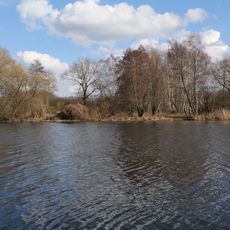
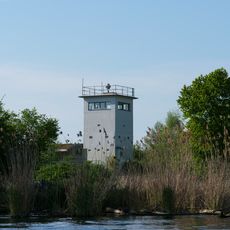
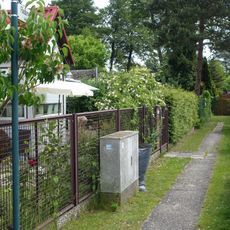
The wreck lies submerged in the Havel-Oder waterway at the former Hennigsdorf border crossing, where the Havel Canal branches off, between the former DDR and West Berlin. It is not on land and cannot be reached on foot; the site is best viewed from a boat on the waterway. The wooden hull sits in the water, so only parts are visible from the surface.
The wreck in the Havel near Hennigsdorf is the barge with registration 10B 11-25 and the 1951 calibration mark H.Bg 254, from the fleet of the Berlin (East) waterway authority. It was sunk in 1969 at the Hennigsdorf border crossing to close a washed-out gap in the border installations; American aerial photographs from that time confirm this.
The community of curious travelers
AroundUs brings together thousands of curated places, local tips, and hidden gems, enriched daily by 92,654 contributors worldwide.