Neuhofener Berg, Urban park in Sendling, Germany
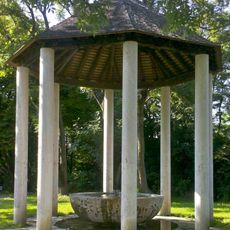
Neuhofener Berg is a park on the left Isar high bank in Munich's Sendling district, bounded west by Plinganserstraße and south by Greinerberg. Its plateau was pushed forward by 2.5 million m³ of rubble from houses destroyed in World War II, piled along the slope. At the north end stands a 1955/56 open round pavilion by Josef Wiedemann with eight 4.5 m travertine columns, a shingled wooden tent roof and a Nagelfluh basin by Hans Wimmer.
The site was created after World War II from debris of destroyed buildings that was piled up to form an elevated landscape. This transformation allowed the creation of new green space for the expanding city.
The name Neuhofen goes back to a country house built by privy councillor Matheus Joner outside the village, raised to noble status by Elector Max Emanuel on 9 October 1698. From 1737 to 1840 the estate belonged to the Zech auf Neuhofen family, whose name it carried. The baroque gardens of the seat are gone; the site is recorded as a ground monument, D-1-7835-0589.
The park is easily accessible on foot with flat and gently sloping paths suitable for different activities. Visitors should note that sports fields are sometimes reserved for teams and parking near the area can be limited.
At the north end of the park stands an open round pavilion built in 1955/56 by Josef Wiedemann, with eight travertine columns 4.5 m tall, a shingled wooden tent roof and a Nagelfluh stone basin by Hans Wimmer. A metal floor plate added by Blasius Gerg in 1969 commemorates the 6,000 Munich residents killed by bombs in World War II.
The community of curious travelers
AroundUs brings together thousands of curated places, local tips, and hidden gems, enriched daily by 92,641 contributors worldwide.