Basthorst Manor, Manor house in Basthorst, Germany
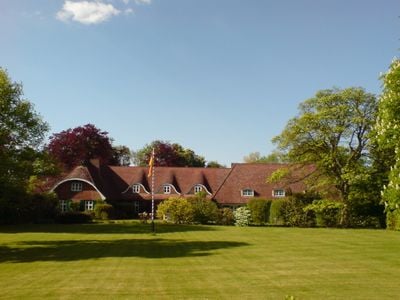
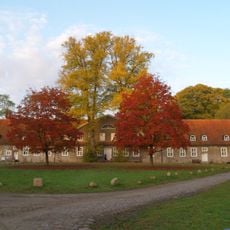
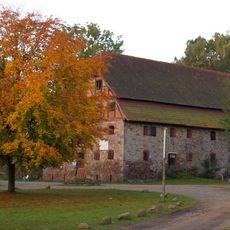
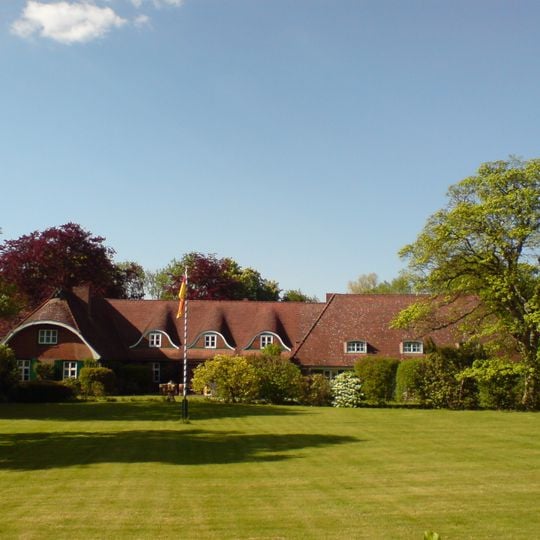
Basthorst Manor is a long, low manor house with pale red-brown brick walls and a steeply pitched red tiled roof, its left section marked by a curved gable and a small entrance porch with green-framed windows and a white door. Small dormer windows sit in the roof, and a flagpole with a yellow and red striped flag stands in front. The house has grown into an asymmetrical three-winged layout, and the farmyard around it keeps a granary of 1771 and a barn of 1862.
The estate's documented history begins in 1391 with the mention of "Johan Schacken to der Basthorst", when it was a fortified castle. In 1645 Dorothea von Schack sold it to the Dutch merchant Peter von Uffeln, who made it inheritable by women. The von Plessen family built the present manor house around 1750, and from 1843 it belonged to the von Brusselle family.
The estate's documented history begins with the mention of "Johan Schacken to der Basthorst" in 1391, when it was a fortified castle. The Schacken family, who came to the northern Elbe region in the 12th century as companions of Henry the Lion, also owned the 1,400-hectare Hahnheide. Today owner Enno Freiherr von Ruffin, second husband of singer Vicky Leandros, runs farming and an events business for festivities here.
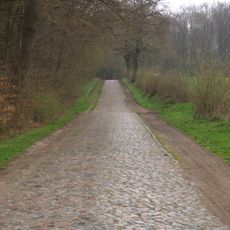
The regional train RE1 from Hamburg to Schwarzenbek brings travelers nearby, and from there a local bus runs to Basthorst stop. The paths between the buildings are unpaved, so sturdy shoes are recommended during wet weather.
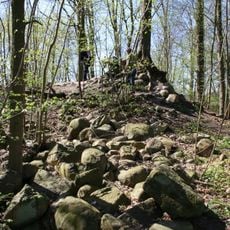
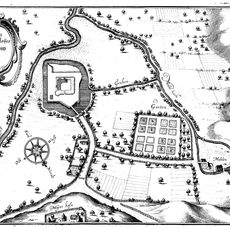
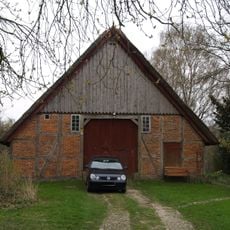
The estate's oldest surviving structure is not the manor house but a granary built in 1771, now used as office space; a barn from 1862 serves for drying. Traces of the wide moat and bastions that Duke Franz Albrecht had laid out around 1640 are still visible in places on the grounds.
The community of curious travelers
AroundUs brings together thousands of curated places, local tips, and hidden gems, enriched daily by 94,653 contributors worldwide.