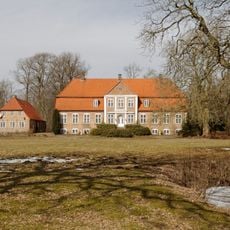
Gut Roest, Manor house in Kappeln, Germany
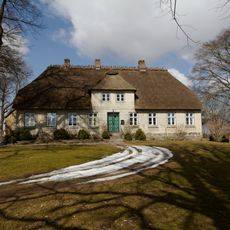
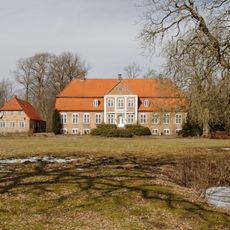
Gut Roest is a manor house west of Kappeln whose main building consists of two gabled houses joined eaves-to-eaves but offset from one another: the oldest part was built in 1590 by Asmus von Rumohr, and his grandson Heinrich added the left wing in 1641. The two sections are timber-framed with brick infill under steep tiled roofs, and the old knight's hall retains an open fireplace.
The estate was first documented in 1231 in King Waldemar's land register and belonged to the Rumohr family from 1498 to 1797, spanning nearly three centuries. This long ownership shaped the history of the surrounding area.
The old knight's hall features a wall painting from 1640 showing a nobleman engaged in falconry, framed by Latin inscriptions. This artwork reveals the artistic and social preferences of that era.
The estate sits near the B 201 road heading toward Schleswig and is easy to locate. Visitors should inquire locally about access times and whether guided tours are available.
Detlef von Rumohr, who took over the estate in 1667, had earlier been ransomed from Turkish captivity by the citizens of Kappeln; he then tried to force those same townspeople into serfdom. Around 64 families left and founded Arnis on a spit in the Schlei, today Germany's smallest town. His epitaph hangs in Kappeln's St. Nikolai church.
The community of curious travelers
AroundUs brings together thousands of curated places, local tips, and hidden gems, enriched daily by 94,418 contributors worldwide.