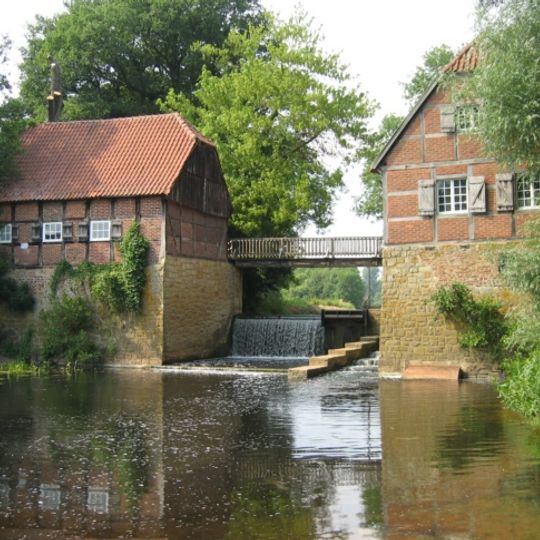
Haus Langen, Water castle in Telgte, Germany
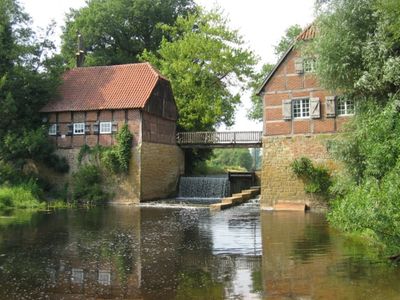
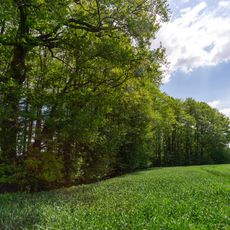
Haus Langen is a former knight's estate whose surviving house stands on the middle of three small islands west of the former core castle. The core was an irregular oval island ringed by two concentric moats with a total diameter of 350 m. The oldest parts of the present house date from the early 17th century; a kitchen wing was added before 1830, and the outbuildings date from the mid-18th century.
Haus Langen takes its name from the knights von Langen; the Bishop of Münster's overlordship is documented in 1150. In 1276 Bishop Everhard von Diest had Burg Langen destroyed, and it was never rebuilt. The estate passed by heiress to the von Letmathe family in 1378, and in 1622 the earthworks served Westbevern's farmers as a refuge during the Thirty Years' War. A testamentary provision brought it to Bernhard Engelbert Christian von Beverförde-Werries in 1702.
The name comes from the knights von Langen, one of two Westphalian noble families of that name, the one with lozenges in its coat of arms. In the Thirty Years' War the ramparts served in 1622 as a refuge for the farmers of Westbevern. In summer 1935 the artist Otto Pankok lived and painted at the moated house for a short time.
The site is most easily reached by bicycle or bus, as there are no parking facilities for cars available on the grounds. Visitors should allow time to walk through the property and view the different buildings at a comfortable pace.
A water mill once stood on this property, first producing oil and later grinding grain for centuries. The mill continued working until the 1960s, reflecting the economic importance the estate once held.
The community of curious travelers
AroundUs brings together thousands of curated places, local tips, and hidden gems, enriched daily by 93,661 contributors worldwide.