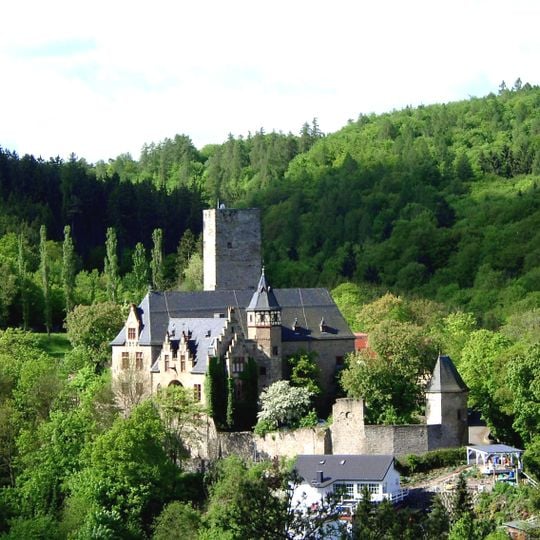
Kransberg Castle, Medieval castle in Usingen, Germany.
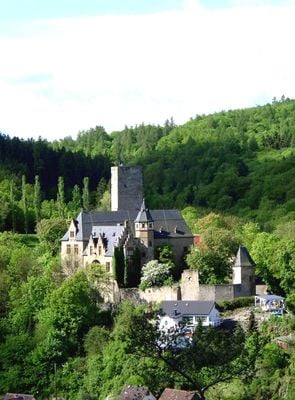
Kransberg Castle is a fortification on a steep rocky outcrop in the Taunus mountains of Hesse, roughly 40 kilometers north of Frankfurt. The structure features medieval stone walls and towers with an inner courtyard, surrounded by additions that reflect different periods of construction.
Built around 1170 as part of a Staufer defensive chain, the castle's oldest surviving element is its bergfried. It passed to the Falkensteins in 1310, the Eppsteins in 1433, and the Waldbott von Bassenheim family in 1654. After falling into disrepair, it was bought by the Duchy of Nassau in 1854 and sold to Arnold von Biegeleben in 1874, who rebuilt it in the neogothic style.
The castle's name comes from an early family that held the land centuries ago. The building shows how owners over time added their own touches, blending medieval strength with later architectural tastes.
The castle is privately owned and occupied by its current owner, who restores it room by room. It now serves as a venue for concerts and other events and as a wedding location with a civil registry office, so visits are tied to these occasions. The Schloßstraße below the castle was closed at times because of falling masonry.
From 1945 the British ran a interrogation centre here, Camp Dustbin, holding figures such as Albert Speer, Wernher von Braun and Hermann Oberth. Questioning focused on German armaments technology, and in summer 1946 the first world conference on biological weapons took place at the castle.
The community of curious travelers
AroundUs brings together thousands of curated places, local tips, and hidden gems, enriched daily by 92,688 contributors worldwide.