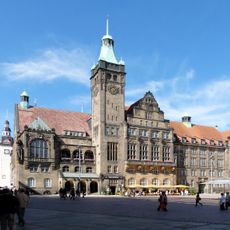
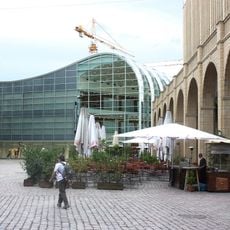
Stadthalle Chemnitz, Multi-purpose hall in Zentrum district, Chemnitz, Germany.
Stadthalle Chemnitz is a multi-purpose hall in the Zentrum district, built from 1969 to 1974 and opened on 4 October 1974. Its Great Hall seats 1,828 people, while the Small Hall holds 560. The building's large-scale cladding uses 4,000 square metres of Rochlitz porphyry, and its concrete facade was designed by Hubert Schiefelbein.
The building opened in 1974, during the era of the German Democratic Republic, and belongs to a generation of large public venues built across East Germany at that time. Its design reflects the planning ideals of that period, favoring function and capacity over ornament.
The foyer holds Horst Zickelbein's mural "Die Befreiung der Wissenschaft durch die sozialistische Revolution", whose colouring now draws more attention than its programme. In the Small Foyer, reliefs by Christa Sammler capture the experience of music, and works by Wieland Förster stand in the adjoining Stadthallenpark. The house has been a listed monument and has received around 16 million visitors since 1974.
The hall sits within easy walking distance of the main train station in central Chemnitz, so arriving by public transport is straightforward. The building is fully accessible and has a parking area with electric vehicle charging points.
In the center of the light hall of the large foyer stands Fritz Cremer's sculpture "Und sie bewegt sich doch! – Galilei", which refers to Galileo's legendary utterance. The work illustrates the principle that nothing remains constant, neither history nor the world as one sees it. The light hall also contains Horst Zickelbein's mural "Die Befreiung der Wissenschaft durch die sozialistische Revolution", whose coloring is notable.
The community of curious travelers
AroundUs brings together thousands of curated places, local tips, and hidden gems, enriched daily by 92,641 contributors worldwide.