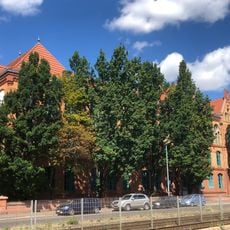
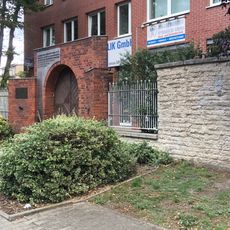
Schlachthof Magdeburg, Cultural heritage monument and slaughterhouse in Magdeburg, Germany
Schlachthof Magdeburg is a former municipal slaughterhouse complex on Liebknechtstraße, laid out in a cross shape: a livestock yard in the east, slaughterhouses in the west, aligned with the cattle drive from south to north. The 1893 buildings are yellow brick with steel roof structures and reduced historicist detailing; Johannes Göderitz added reinforced-concrete extensions, a coal bunker and a cold store from 1924.
The complex was built in the late 1800s as the city's municipal slaughterhouse and served as a key part of meat supply during industrialisation. Decades later, the operation closed and the site was eventually repurposed and preserved for contemporary use.
The streets crossing the site were given names recalling its trade: Zur Viehbörse, Zum Handelshof and Johann-Gottlieb-Schoch-Straße, the last honouring the Magdeburg merchant Johann Gottlieb Schoch. The former pig market hall now houses a large Kaufland supermarket, so everyday shopping takes place under the old hall roof.
The site is reached via Liebknechtstraße 35, but today it is opened up by the former factory streets, now public roads: Zur Viehbörse, Zum Handelshof and Johann-Gottlieb-Schoch-Straße. The grounds are laid out in a cross shape, with the livestock yard in the east and the slaughterhouse in the west, following the north-south cattle drive. Some buildings are rented to new users, others were demolished, so orientation follows the surviving yellow-brick structures.
The site's layout follows the direction of the cattle drive: animals entered from the south and moved north, with the livestock yard on the east side and the slaughterhouses on the west. The complex was reached by its own railway connection on an 11-hectare plot outside the former fortifications.
The community of curious travelers
AroundUs brings together thousands of curated places, local tips, and hidden gems, enriched daily by 94,072 contributors worldwide.