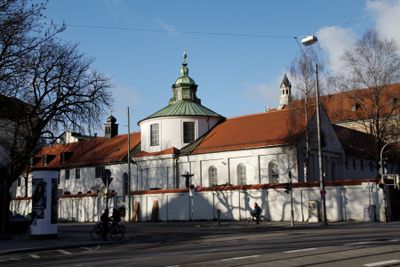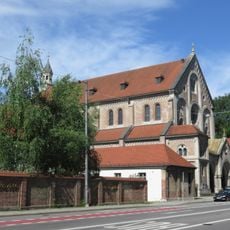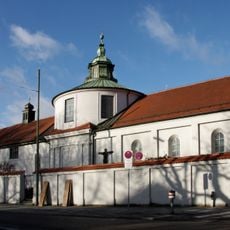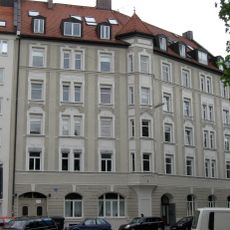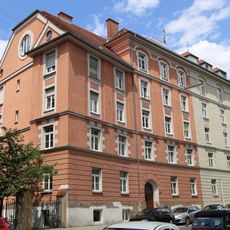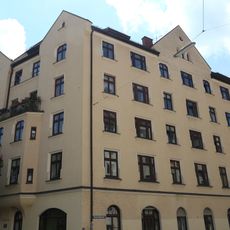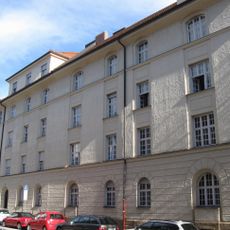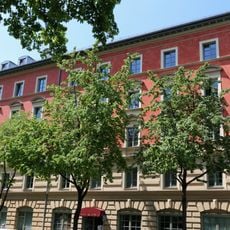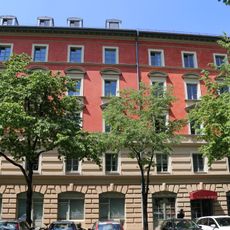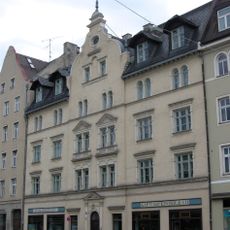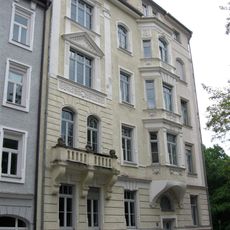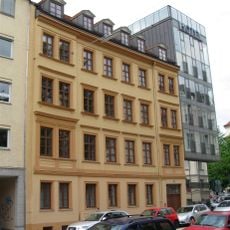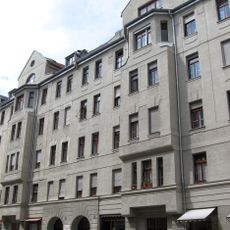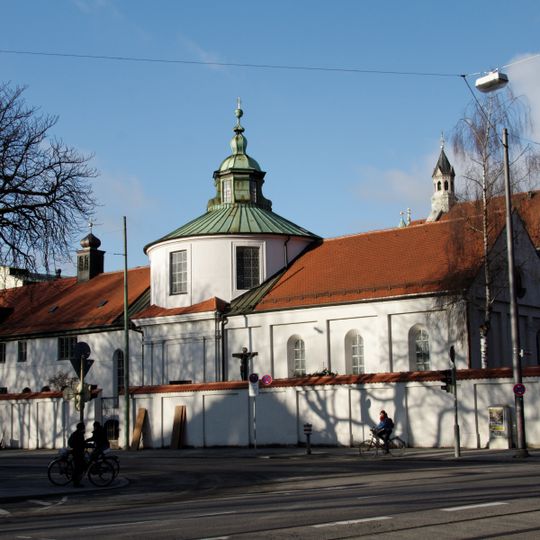
Kapuzinerkloster, Capuchin monastery in the Isarvorstadt, Munich, Germany
The Capuchin Monastery is a religious compound in central Munich built with simple stone walls and a rectangular courtyard bordered by covered arcades. The structure shows a clear layout where the inner court serves as the heart, with surrounding buildings housing spaces for daily life and prayer.
Maximilian I called the Capuchins to Munich around 1600; their first monastery stood outside the city wall at today's Lenbachplatz, and part of its grounds was absorbed into the Kapuzinerbastion. The house was dissolved in 1802 during the secularisation of Bavaria and demolished when the fortifications were levelled. In 1845 King Ludwig I brought the order back and gave it a site beside the 1702 rotunda of the Schmerzhafte Kapelle, where the four-winged monastery was built from 1846 to 1856.
The Capuchin friars now occupy only the former parish house at Isartalstraße 4, a building extending the east wing southward. Since autumn 2008 the four-winged complex has housed the Institut für publizistische Ausbildung, the journalism school of the Catholic Church in Germany, while the parish association Isarvorstadt uses the connecting building as parish hall and office.
The grounds are accessible from outside, but visitors should know that certain areas and times are reserved for prayer and religious services. Planning your visit ahead ensures you can explore while respecting the community's daily practices.
The round chapel of the Schmerzhafte Kapelle, built in 1702, was incorporated into the monastery's east wing and served as the monastery church's choir until the nave was separated again during the 2006–2009 renovation. The Capuchin cemetery lies between the east wing and the wall on Isartalstraße.
The community of curious travelers
AroundUs brings together thousands of curated places, local tips, and hidden gems, enriched daily by 95,692 contributors worldwide.