Heilige-Familie-Kirche, Gothic Revival parish church in Lichterfelde, Berlin, Germany
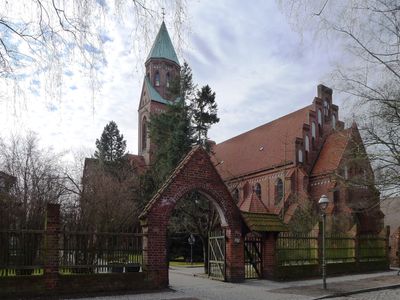
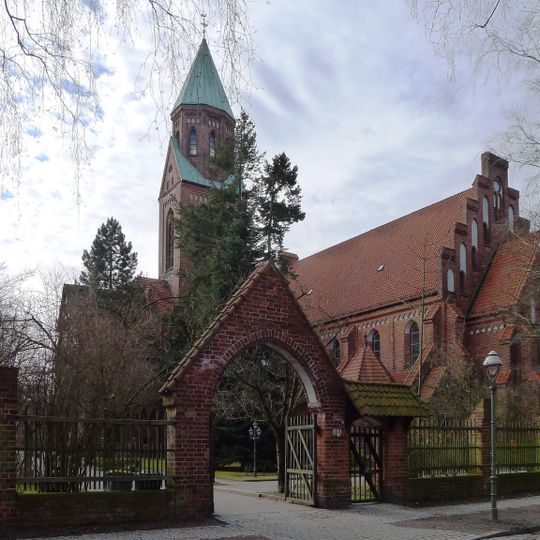
The Holy Family Church is a red brick Gothic Revival church modeled on the three-aisled brick basilica of Lehnin Cistercian Abbey. Its broad central nave and two narrow side aisles are covered by cross-ribbed vaults, with tall pointed windows above the side-aisle roofs. A square tower with a steep pyramidal roof and a brick gateway with a pointed arch stand at the entrance.
The parish bought the Kornmesserstraße plot in 1898 and in 1902 took out a 90,000-mark building loan. Christoph Hehl, architect of the Steglitz Rosary Basilica, designed the church; first pastor Maximilian Beyer oversaw construction at a cost of 191,000 marks. The three bronze bells cast by the Edelbrock brothers were consecrated on 1 May 1904 and later requisitioned for armaments in World War I.
The parish drew servants from Catholic Silesia and, from 1900, workers from Galicia and Poland who built the Teltow Canal. The church's red bricks in medieval monastery format came from a Torgau brickworks, a choice with confessional overtones in Protestant Brandenburg.
The entrance is through a pointed-arch portal on Kornmesserstraße, leading into a porch before the nave. Inside, the broad central nave and narrow side aisles allow a clear view of the ribbed vaults and the raised main apse. The baptismal chapel at the northeast corner is a separate octagonal structure with its own tent roof.
The red bricks were hand-struck in a medieval monastery format from a brickyard in Torgau; this brick format carried confessional-political weight at the time. The tower's three cast-steel bells, cast by the Bochumer Verein in 1921, replaced bronze bells from the Edelbrock brothers that were surrendered for armaments in the First World War and survived the Second.
The community of curious travelers
AroundUs brings together thousands of curated places, local tips, and hidden gems, enriched daily by 94,341 contributors worldwide.