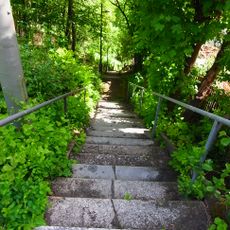
Heslacher Wasserfälle, Artificial waterfall in Heidenklinge valley, Stuttgart, Germany
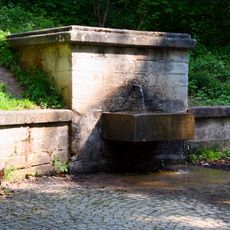
Heslacher Wasserfälle is an artificial waterfall in the Heidenklinge valley fed by a historic water channel system. The cascade flows down through multiple drops over rocks, with forest trails and wooden bridges winding through the gorge.
In 1566 Duke Christoph of Württemberg had a spring in the Pfaffenwald dammed into the Pfaffensee and an 805-metre tunnel, the Herzog-Christoph-Stollen, built to carry its water into the Heidenklinge; work lasted until 1575. Later lakes followed: the Bärensee in 1618, the Steinbachsee and Katzenbachsee in 1812, the Neuer See in 1833. From 1874 the Seewasserwerk took the water, and the 1879 Gäubahn embankment cut the valley.
The name "waterfalls" comes from the Heidenklinge carrying more water until the late 19th century, when feed pipes from the park lakes still supplied it. In the 19th century the falls, together with the adjacent Bürgerwald, Rotwildpark and Hasenberg, were a popular excursion destination. A tourist stop on the Gäubahn, Wildpark, existed about 200 metres away from 1896 to 1961.
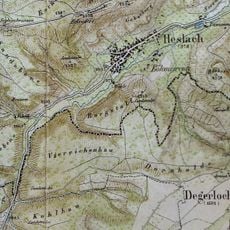
The falls lie in the Vaihingen district of Dachswald, not in Heslach itself, and the Gäubahn embankment cuts across the valley, so approach from the Dachswald side. The stream below the embankment runs gently and is easy to miss. The Heidenklinge is now separated from the Bürgerwald by the B14, so plan the route around that road.
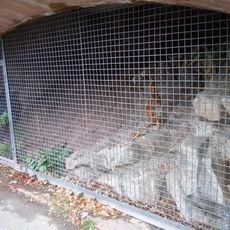
The water flows through a hidden underground channel that runs beneath a railway embankment before emerging as the visible cascades. This concealed engineering lies beneath everyday transportation infrastructure that most visitors pass unaware.
The community of curious travelers
AroundUs brings together thousands of curated places, local tips, and hidden gems, enriched daily by 94,608 contributors worldwide.